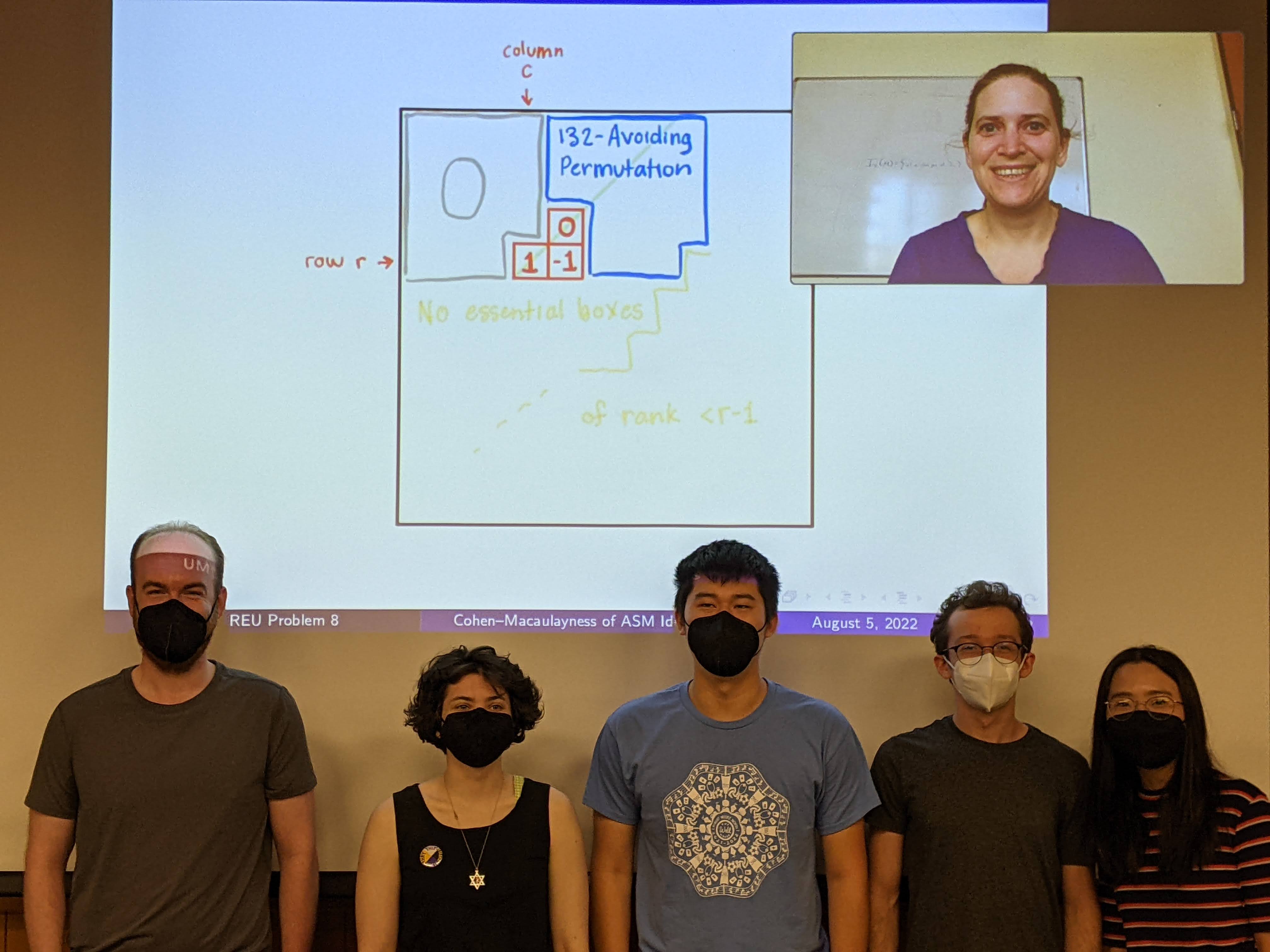
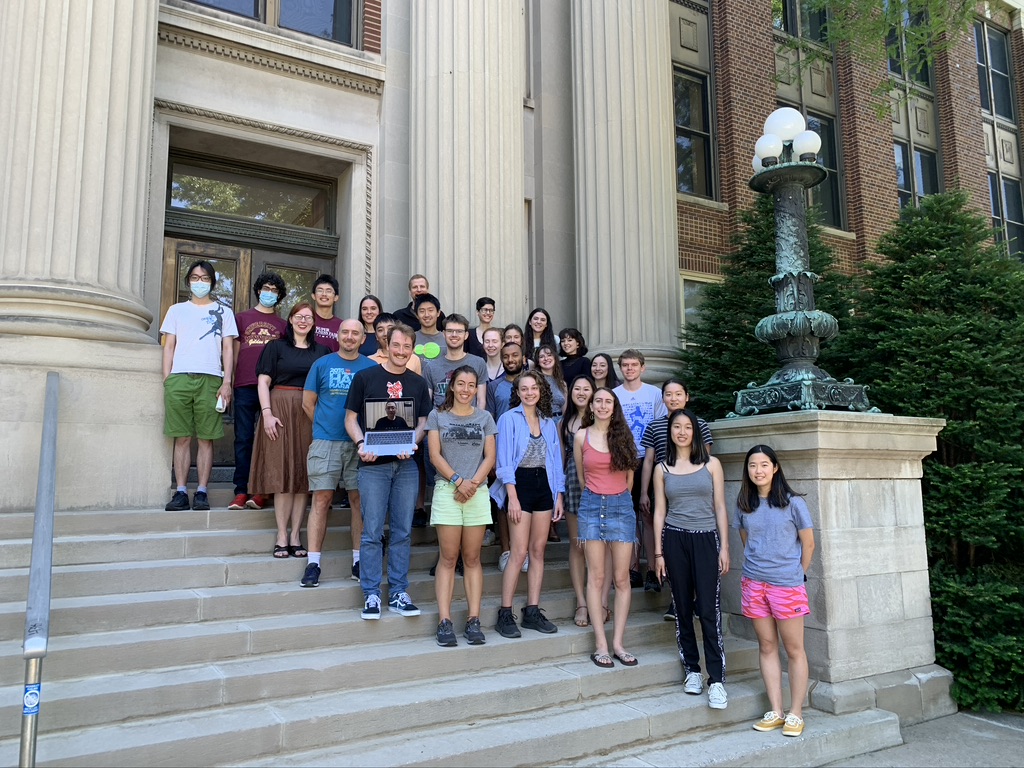
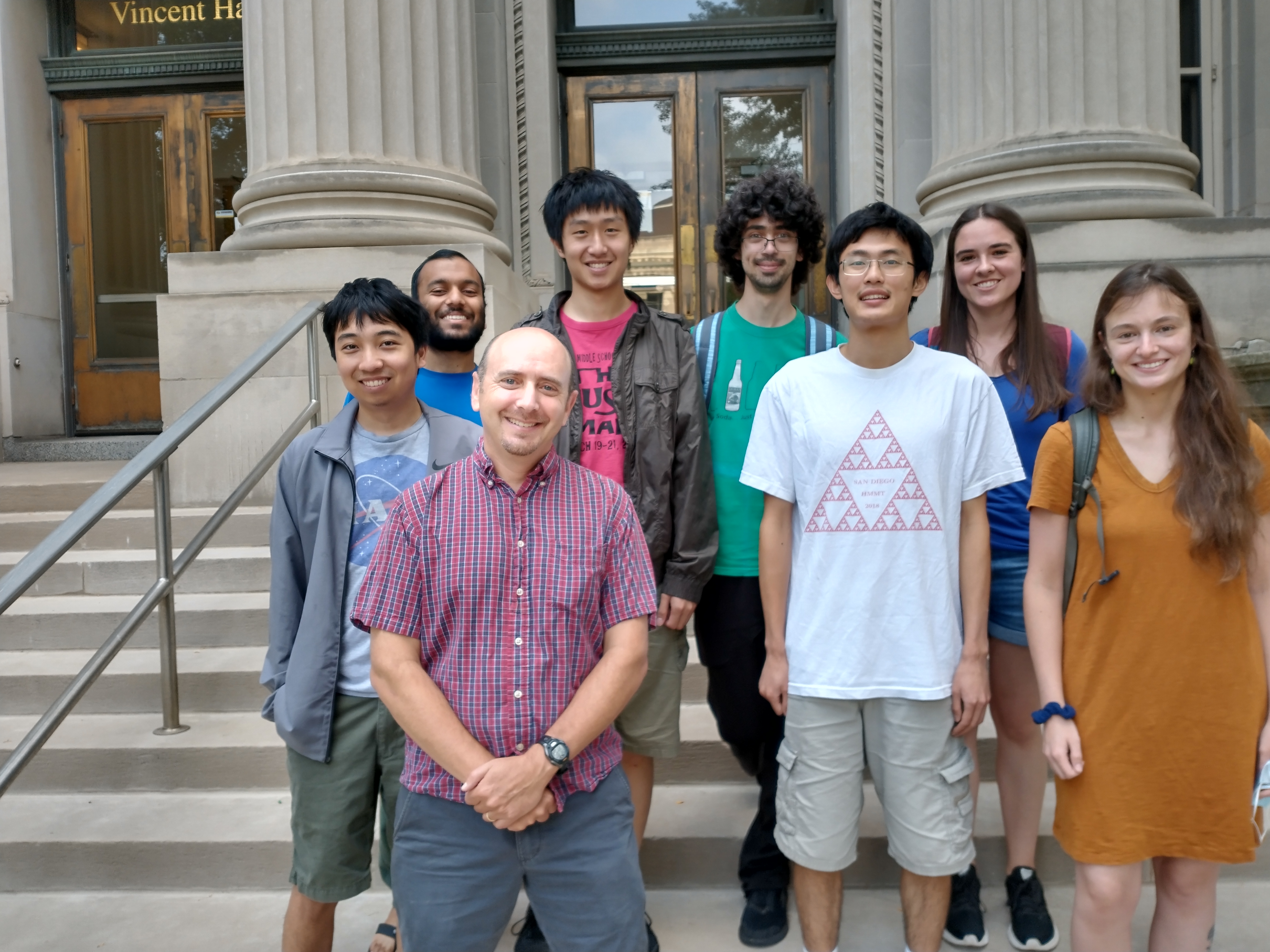
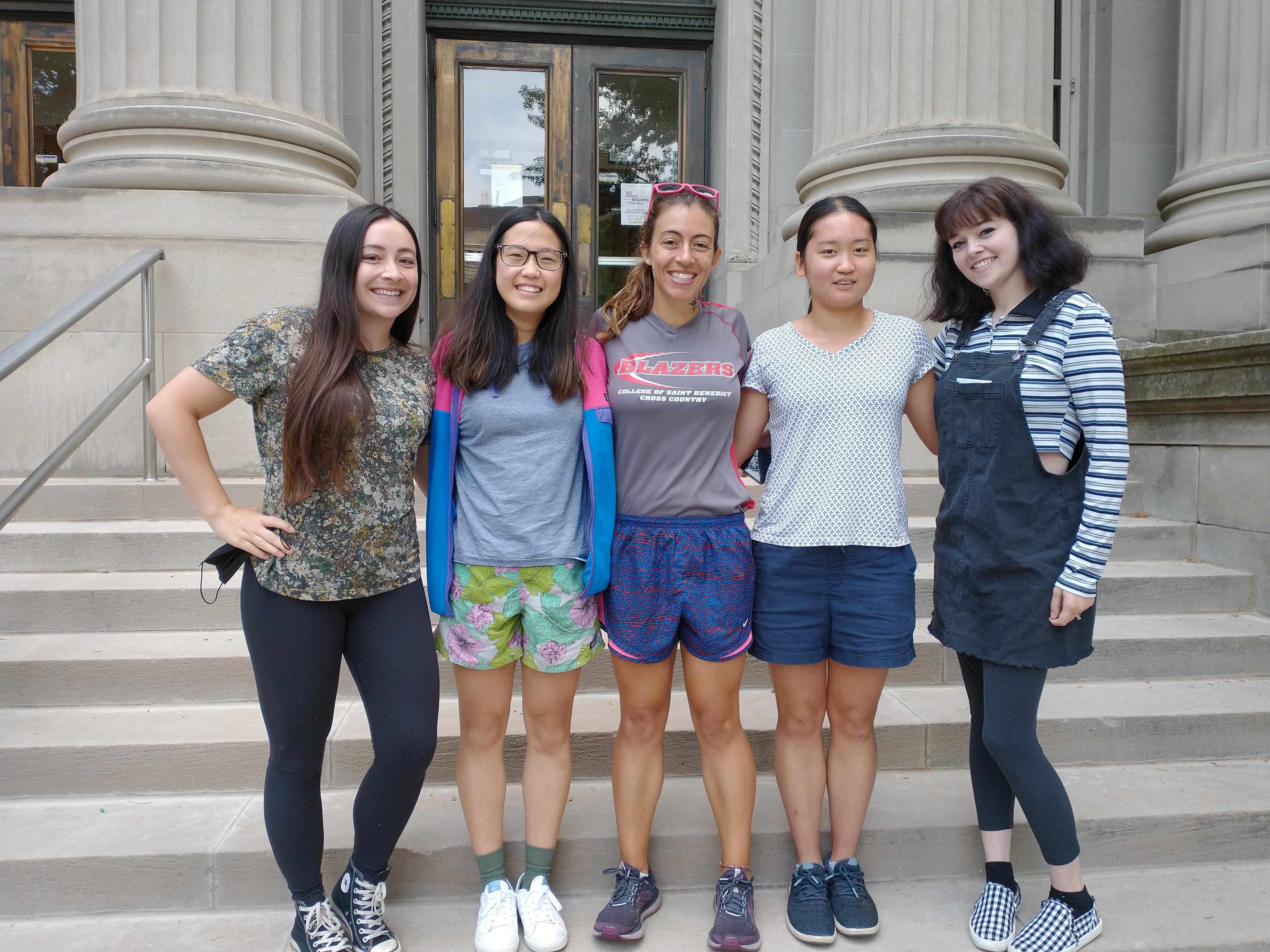
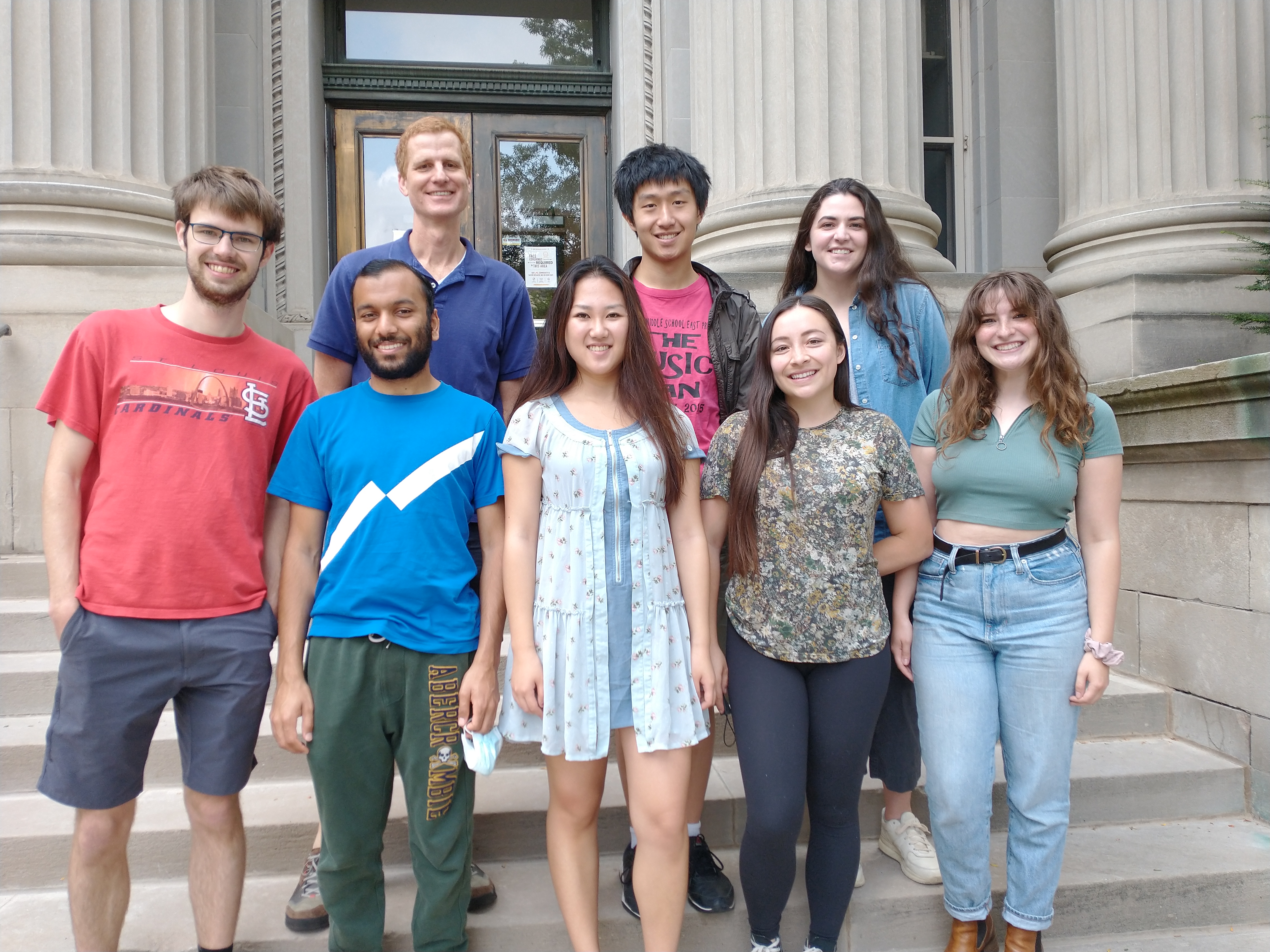
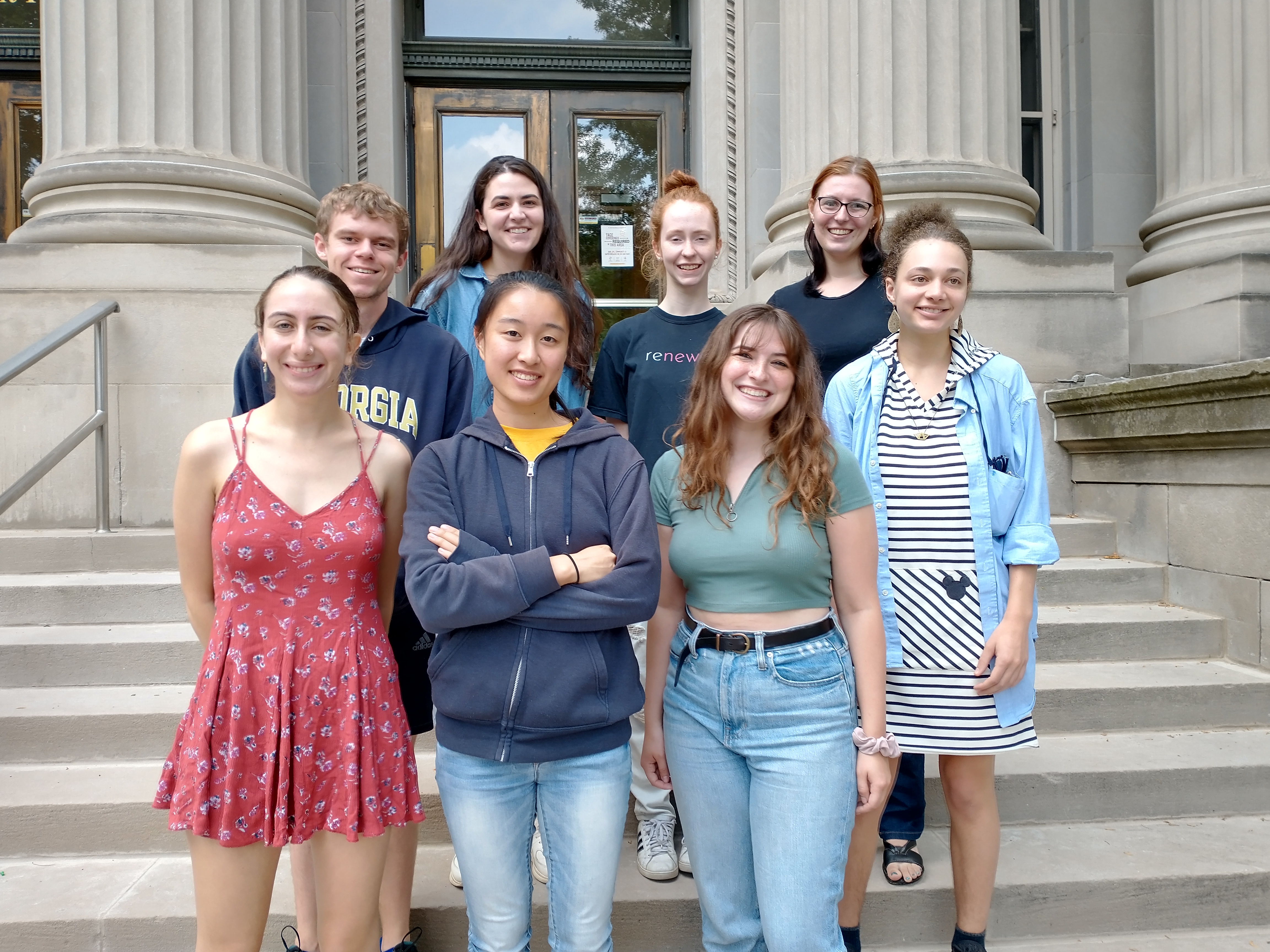
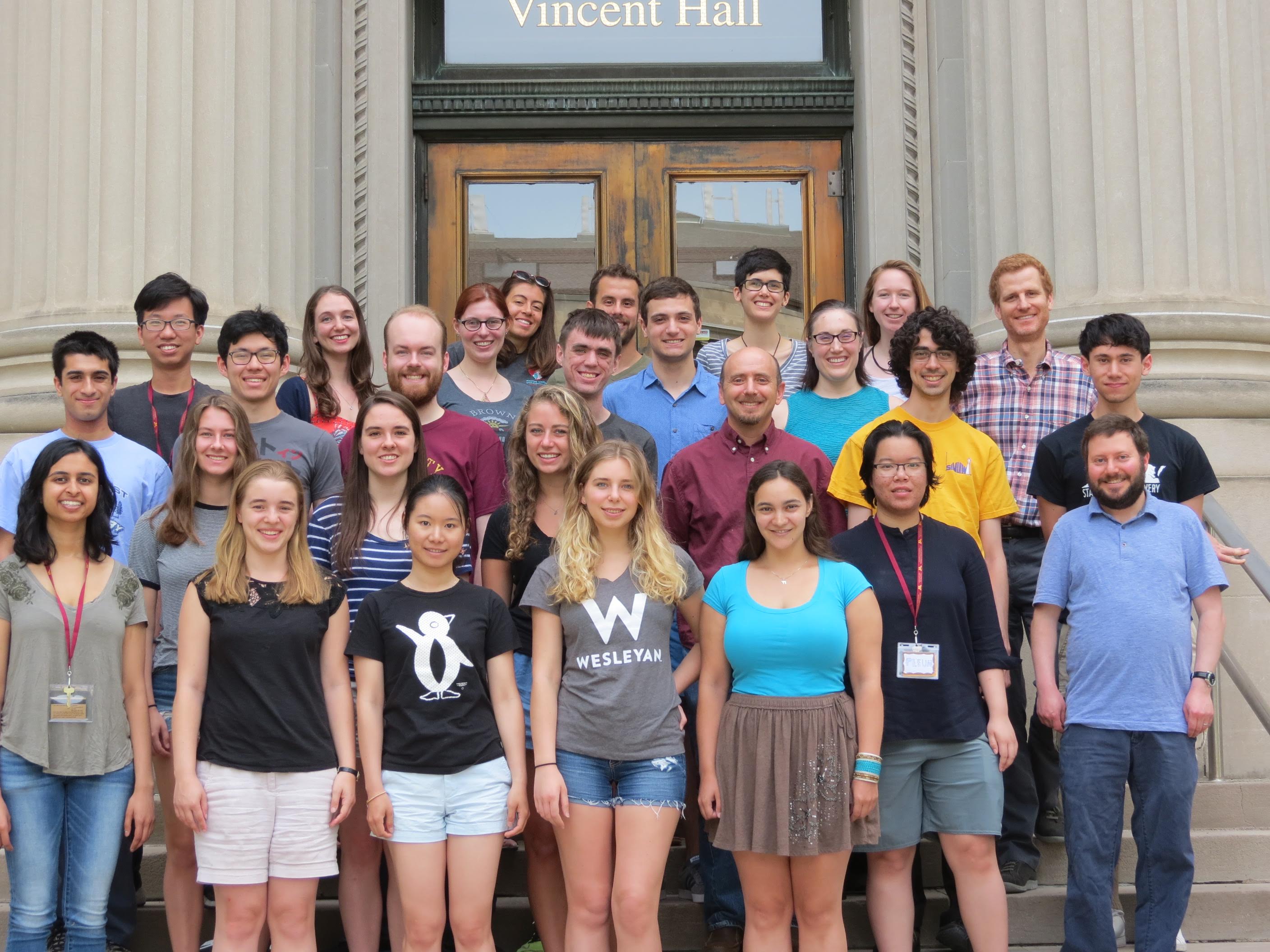
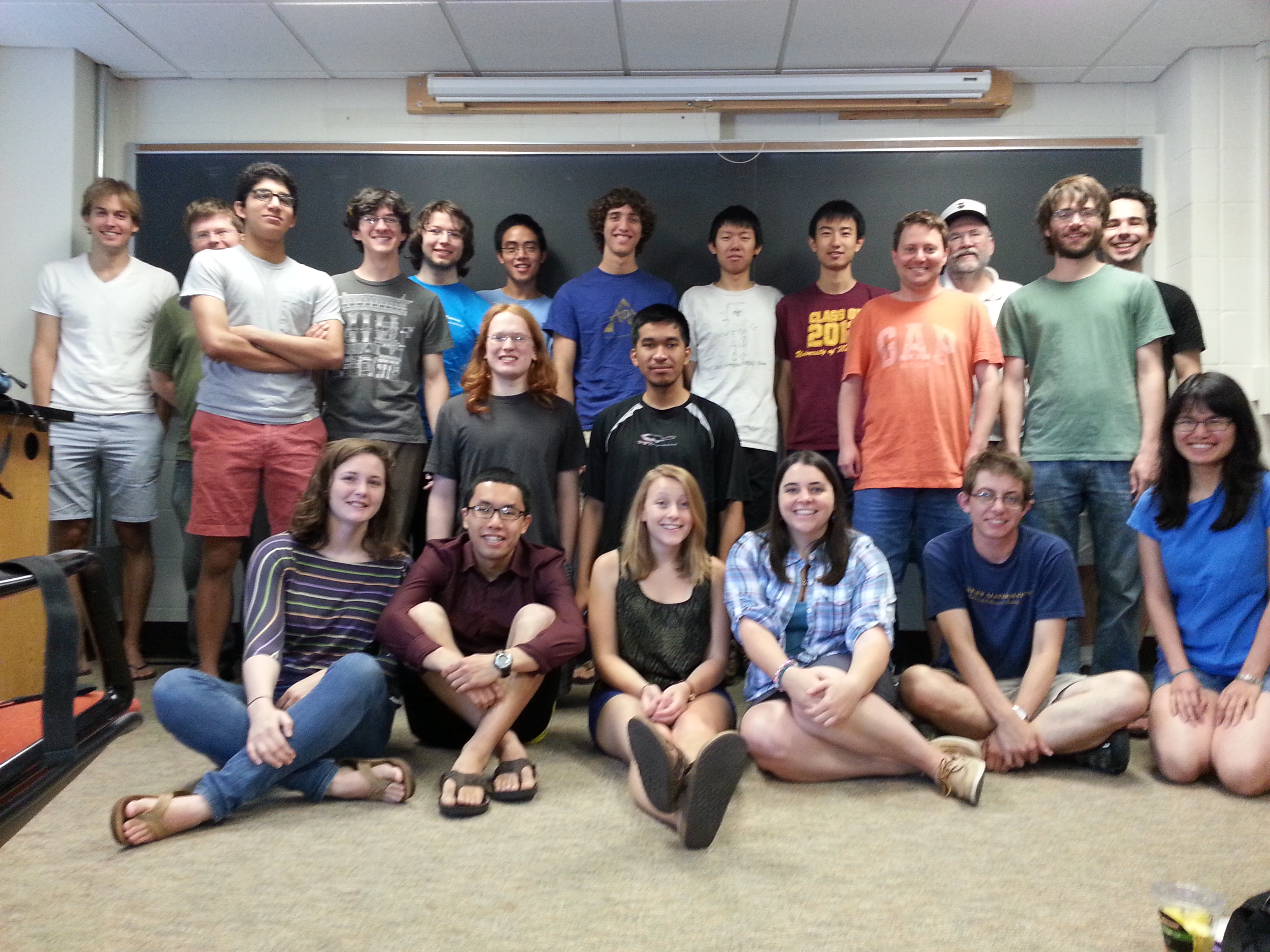
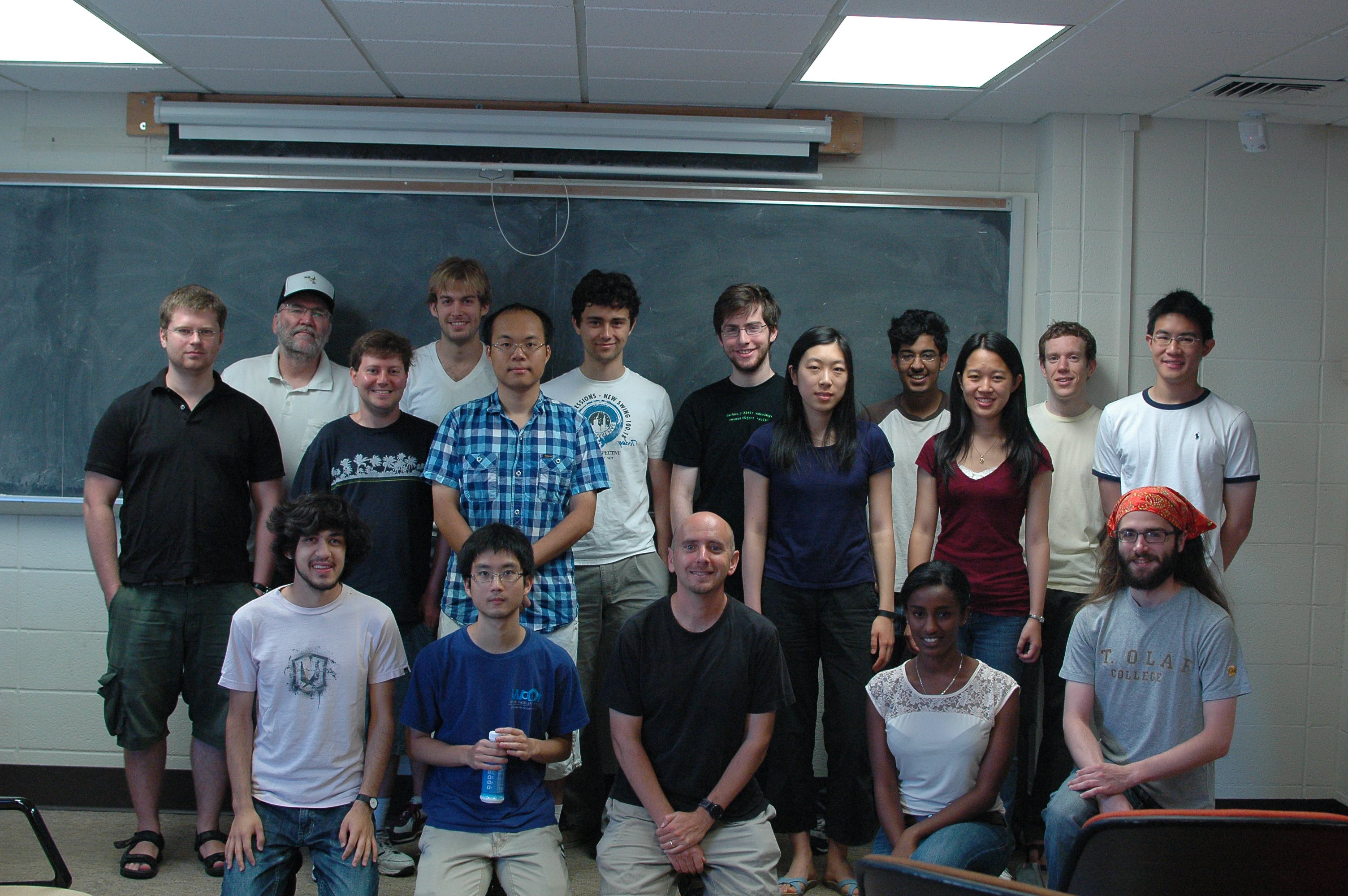
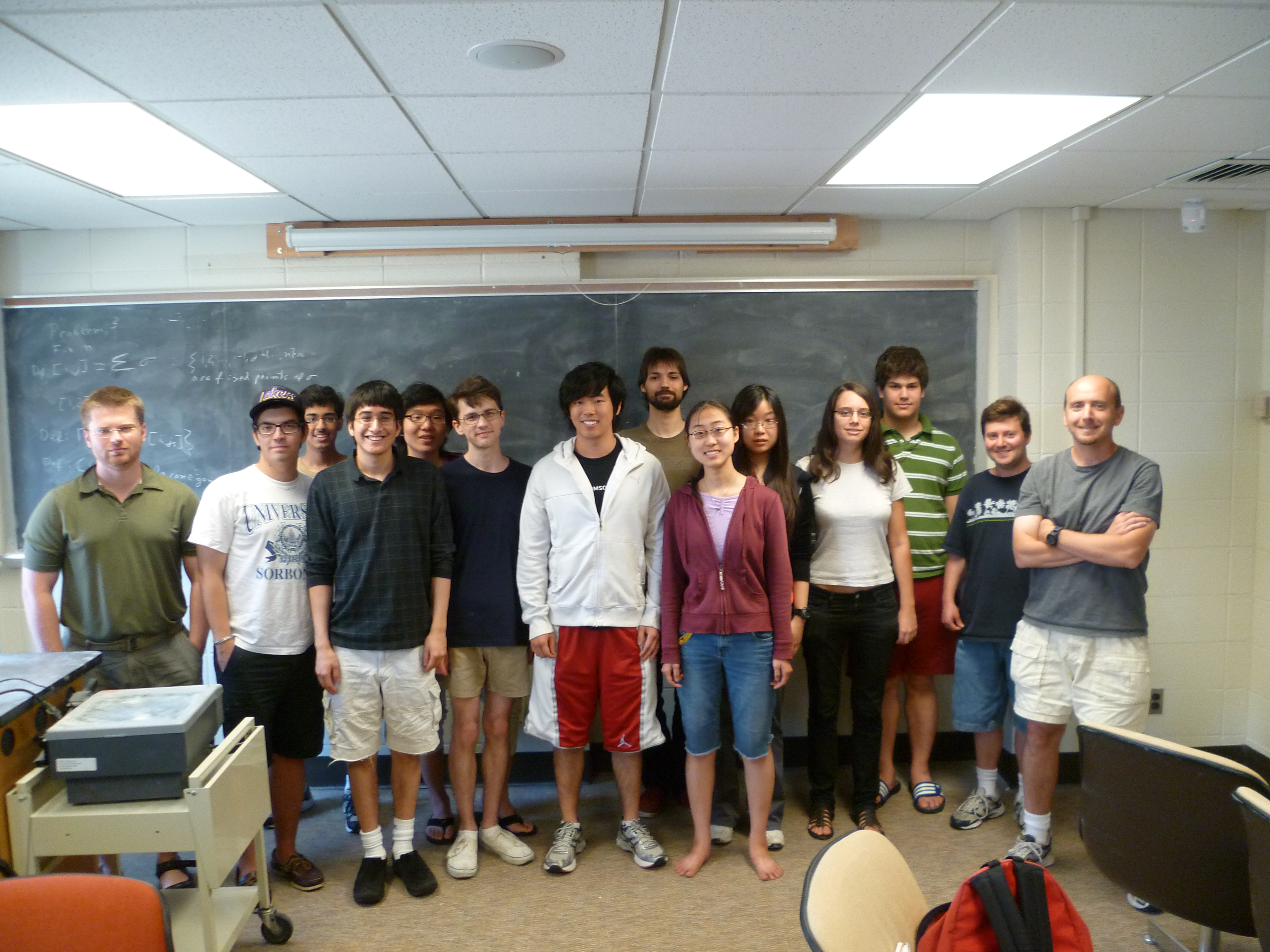
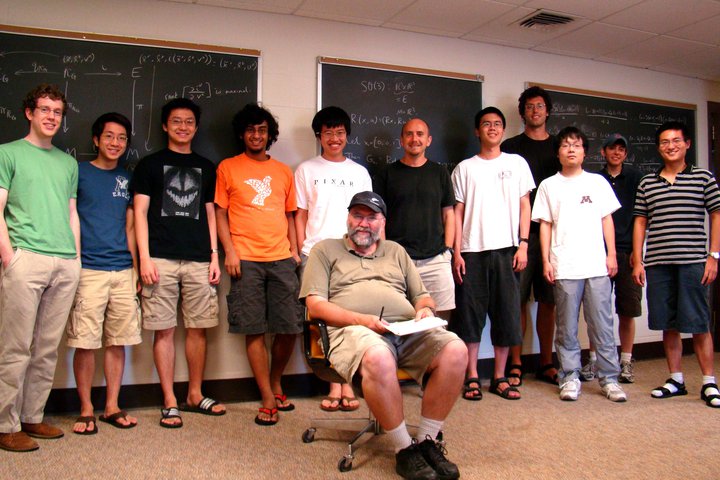
Upcoming Summer 2024 info
Mentors (asterisk indicates coordinators):
Ayah Almousa*, Christine Berkesch, Chris O'Neill, Pasha Pylyavskyy, Vic Reiner*, Shiyun Wang, Kayla Wright
15 participants:
Serena An, Casey Appleton, Molly Bradley, Tim Cho, Sogol Cyrusian,
Kieran Favazza, Aleister Jones, Nzingha Joseph, Molly MacDonald, Zach Medlin, Saskia Solotko, Mario Tomba Marillo, Katherine Tung, Philip Yang, Yuchong Zhang
TAs:
Elise Catania, Tara Gomes, Meagan Kenney, Joe McDonough, Miranda Moore, Eduardo Torres, Kaelyn Willingham
An asterisk indicates the REU coordinator.
Polymath Jr. 2023 (online)
Brubaker mentored again in the 4th installment of the
Polymath Jr. REU.
TA: Suki Dasher.
Polymath Jr. 2022 (online)
Brubaker mentored again in the 3rd installment of the
Polymath Jr. REU.
TA: Andy Hardt.
Swapnil Garg, Frank Lu, Kevin Ren and Brian Sun studied various aspects of the invariant theory of
cyclic groups acting on a polynomial ring in characteristic zero. They studied the coinvariant algebra,
the resolution of the polynomial ring over the invariant ring, and the invariant ring as a module over the
symmetric polynomials.
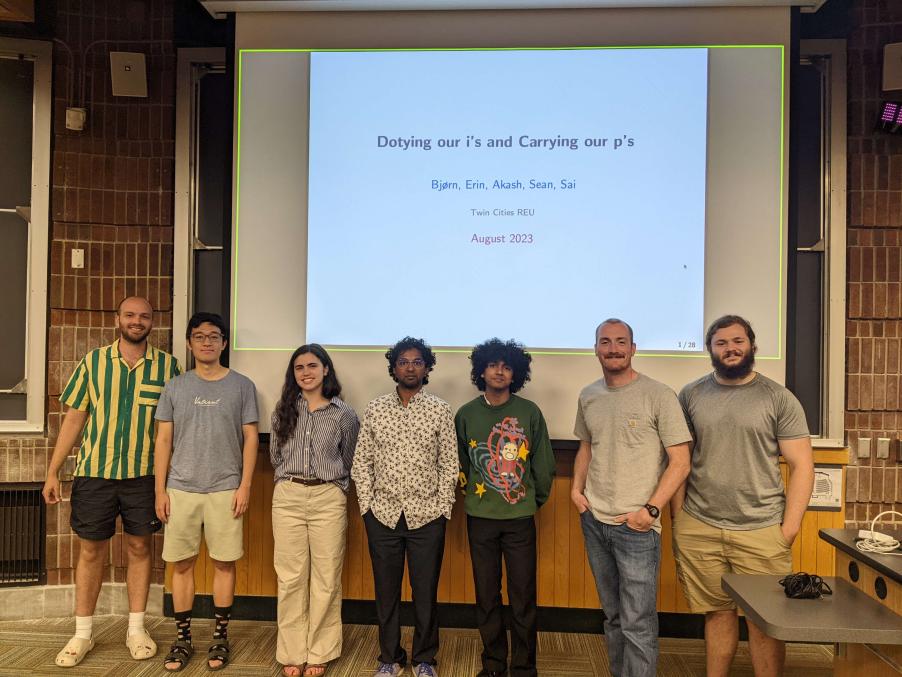
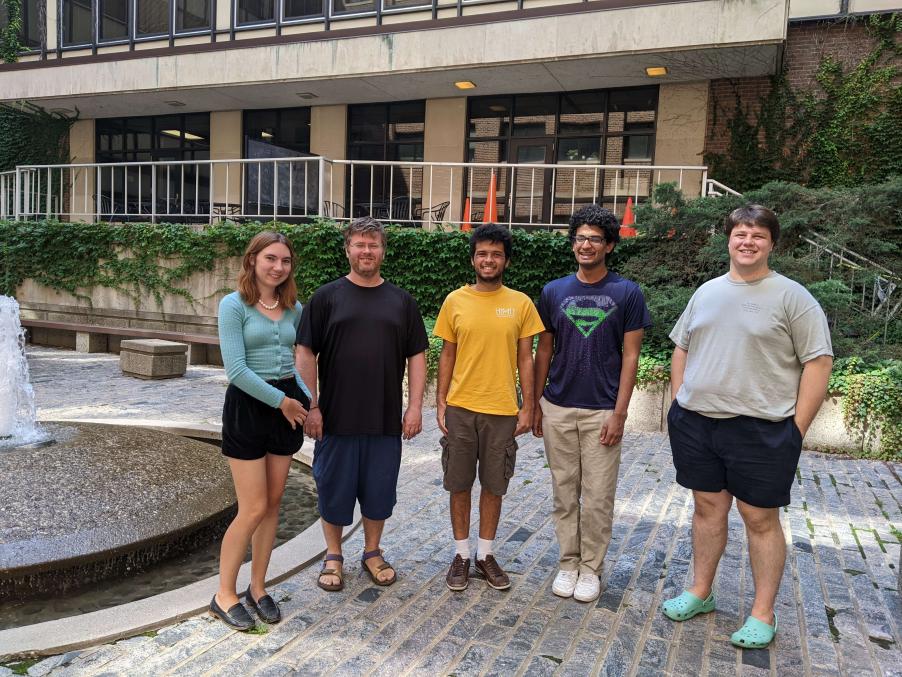
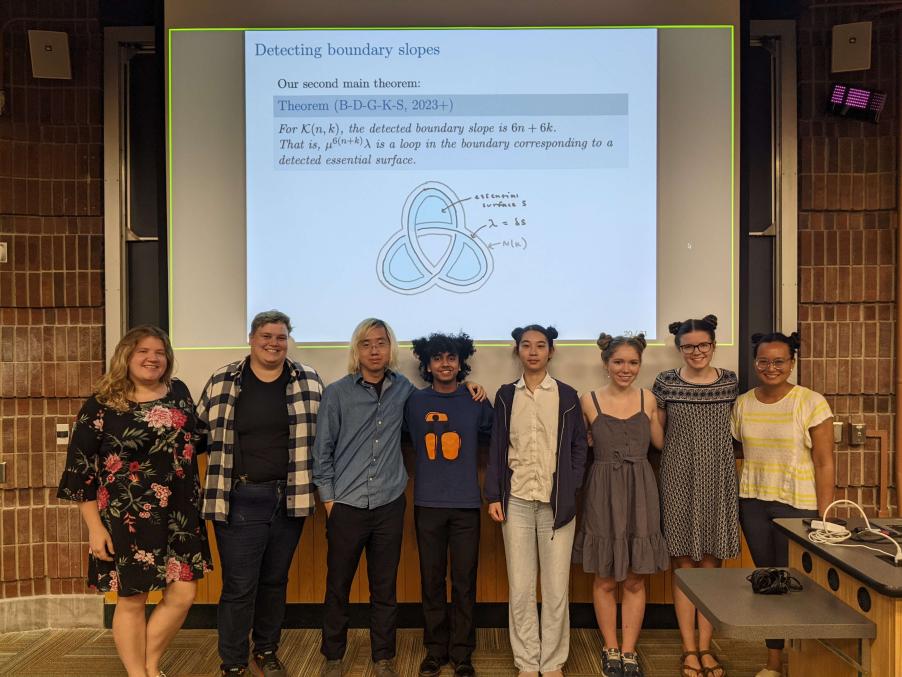
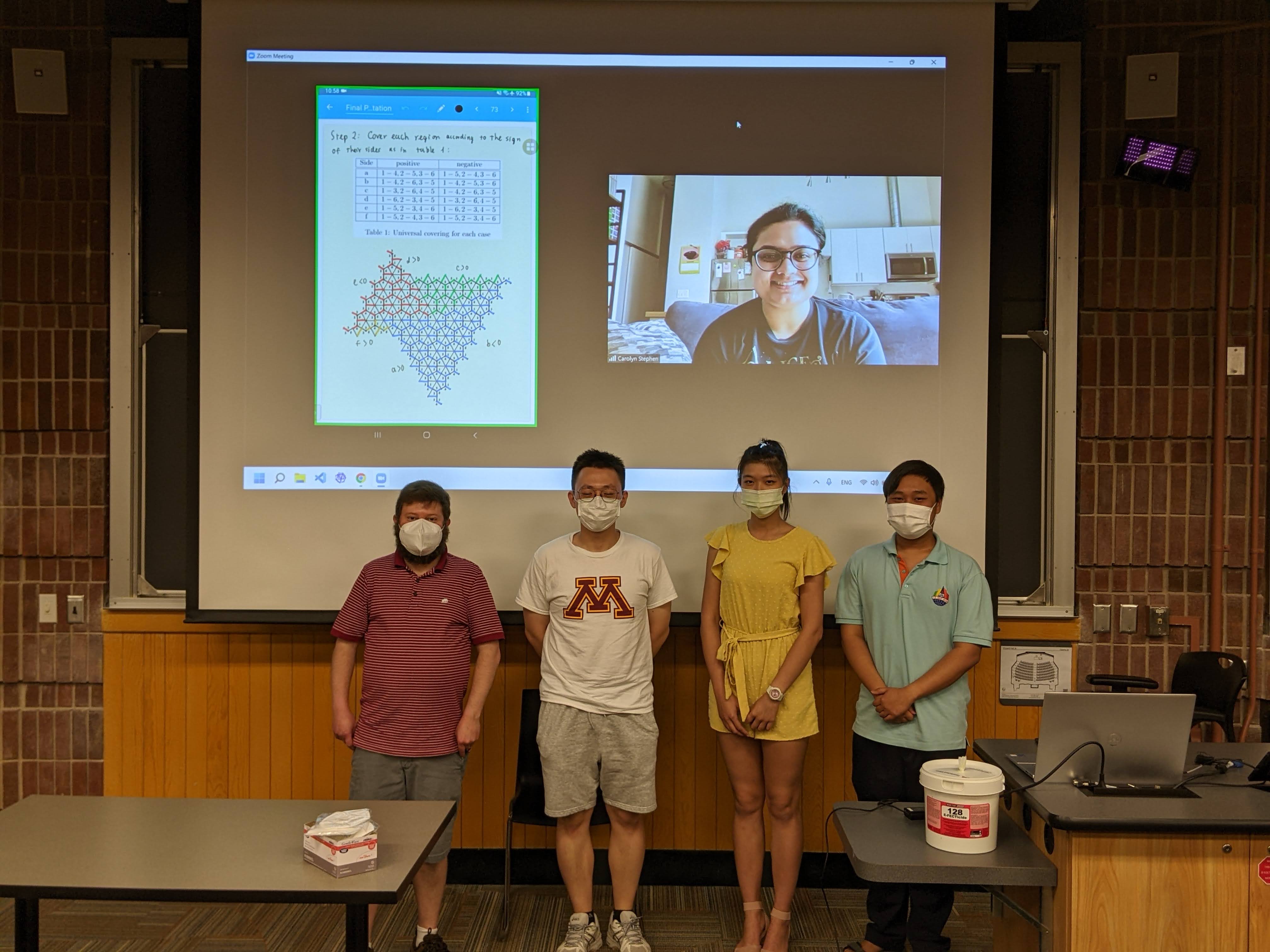
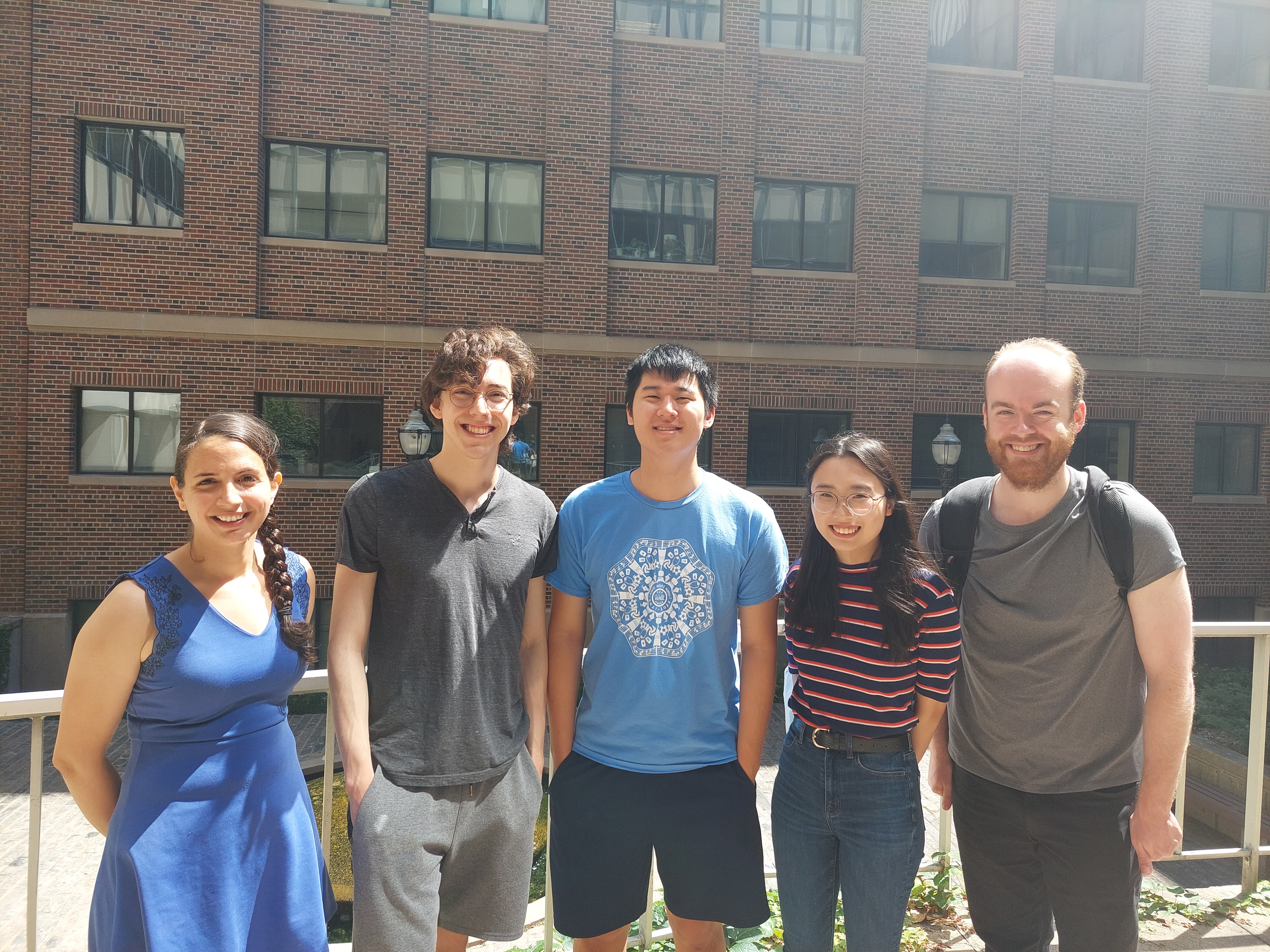
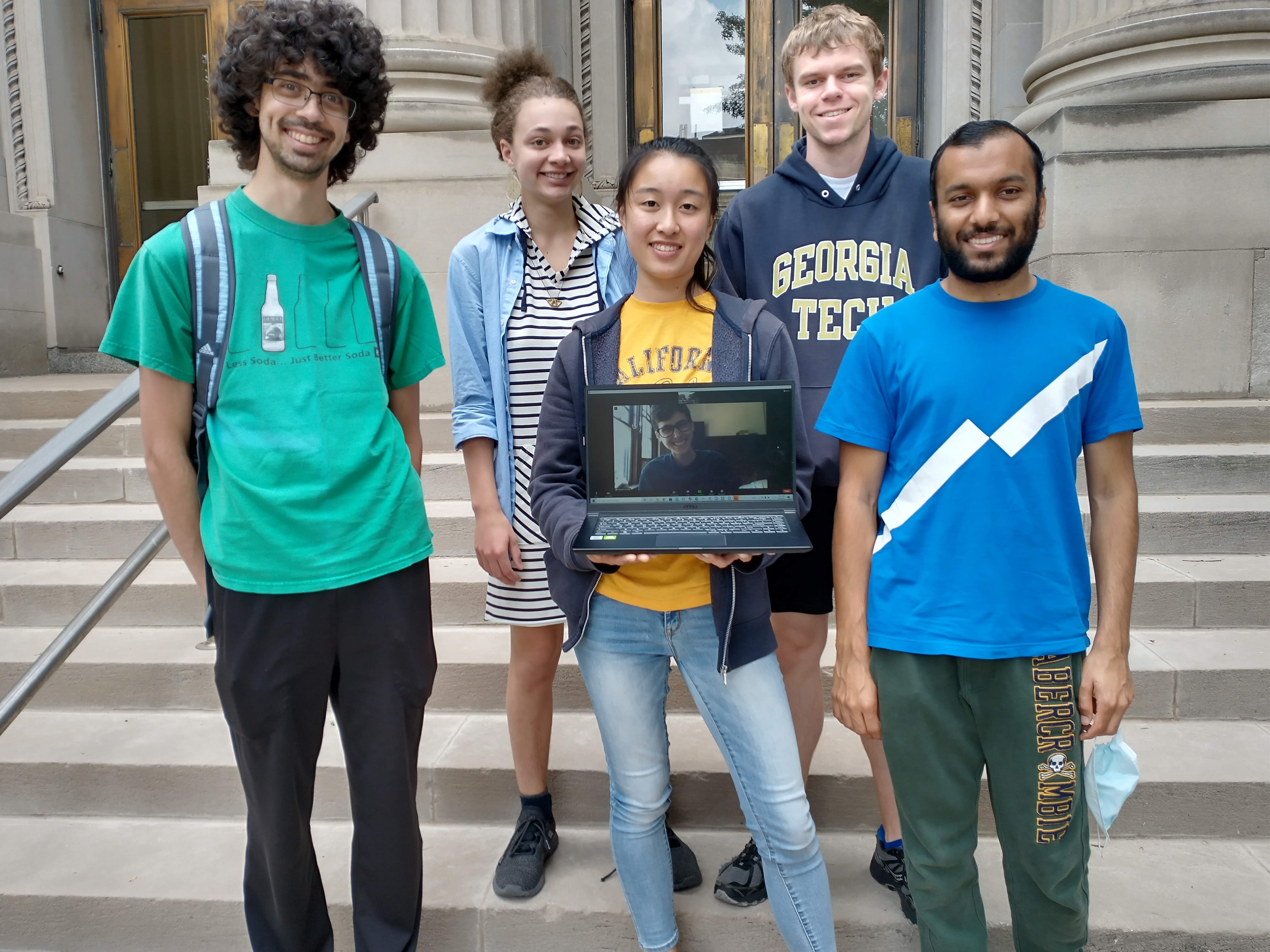
Here is their
group photo,
final presentation, and
report.
Amy Tao and Joy Zhang explored the characterization of unitary friezes on a polygon over Z[√2] and Z[√3]. While in Z[√2] they found a whole family of dissections involving squares and triangles that give rise to a unitary frieze, they claim that in Z[√3] the only unitary friezes come from triangulations.
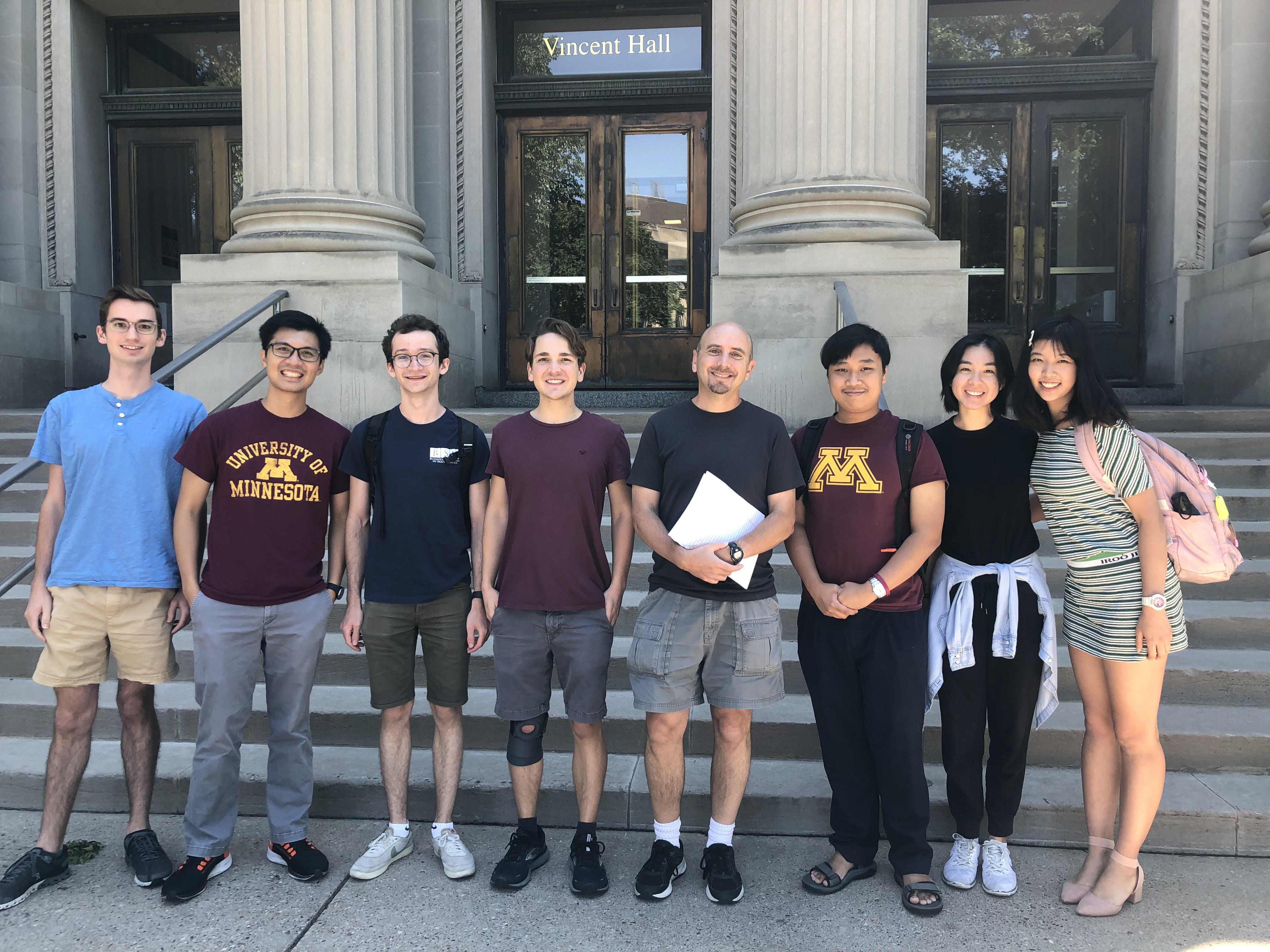
Here is their
group photo,
final presentation,
report, and an ensuing
arXiv preprint.
Noah Caplinger, Arian Chin, Nyah Davis and Swapnil Garg
studied certain stable ratios of F-polynomials that arise in cluster algebras associated to r-Kronecker quivers. They found functional equations for a family of these F-polynomial ratios using purely algebraic methods and were able to find closed form solutions in some special cases. In particular, they completely solved the r=2 case, including a particular stable F-polynomial ratio that had previously been computed by Reading via scattering diagrams. Their method avoids the need for this more sophisticated construction.
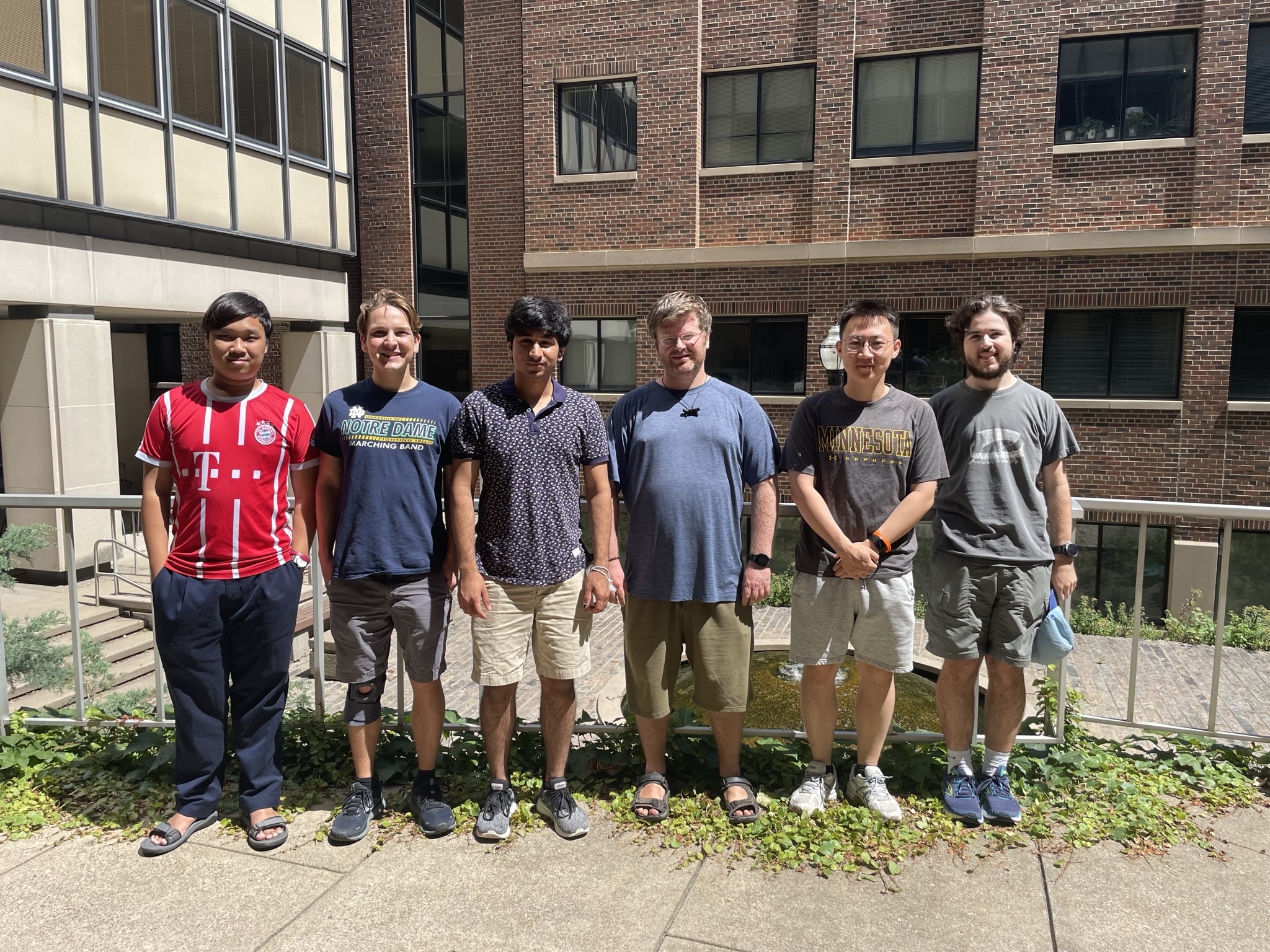
Here is their
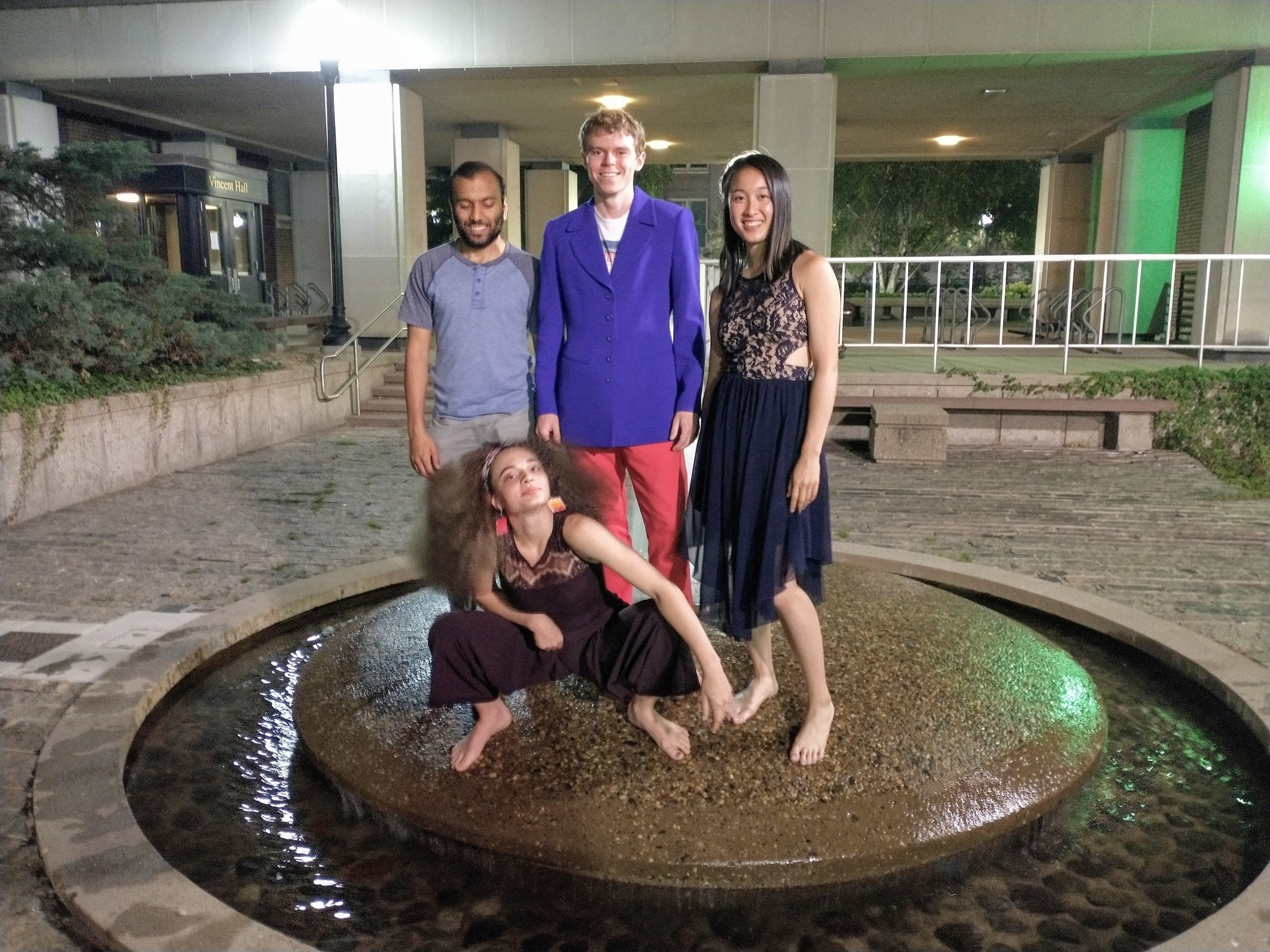
group photo,
group photo at MathProm,
final presentation, and
report.
Swapnil Garg, Aidan Kelley, Frank Lu and Siki Wang studied a conjecture of Bump, asserting that a certain
multiple Dirichlet series appearing in work of Chinta should coincide with certain exponentials appearing inside formulas for Whittaker coefficients from work of Brubaker and Friedberg.
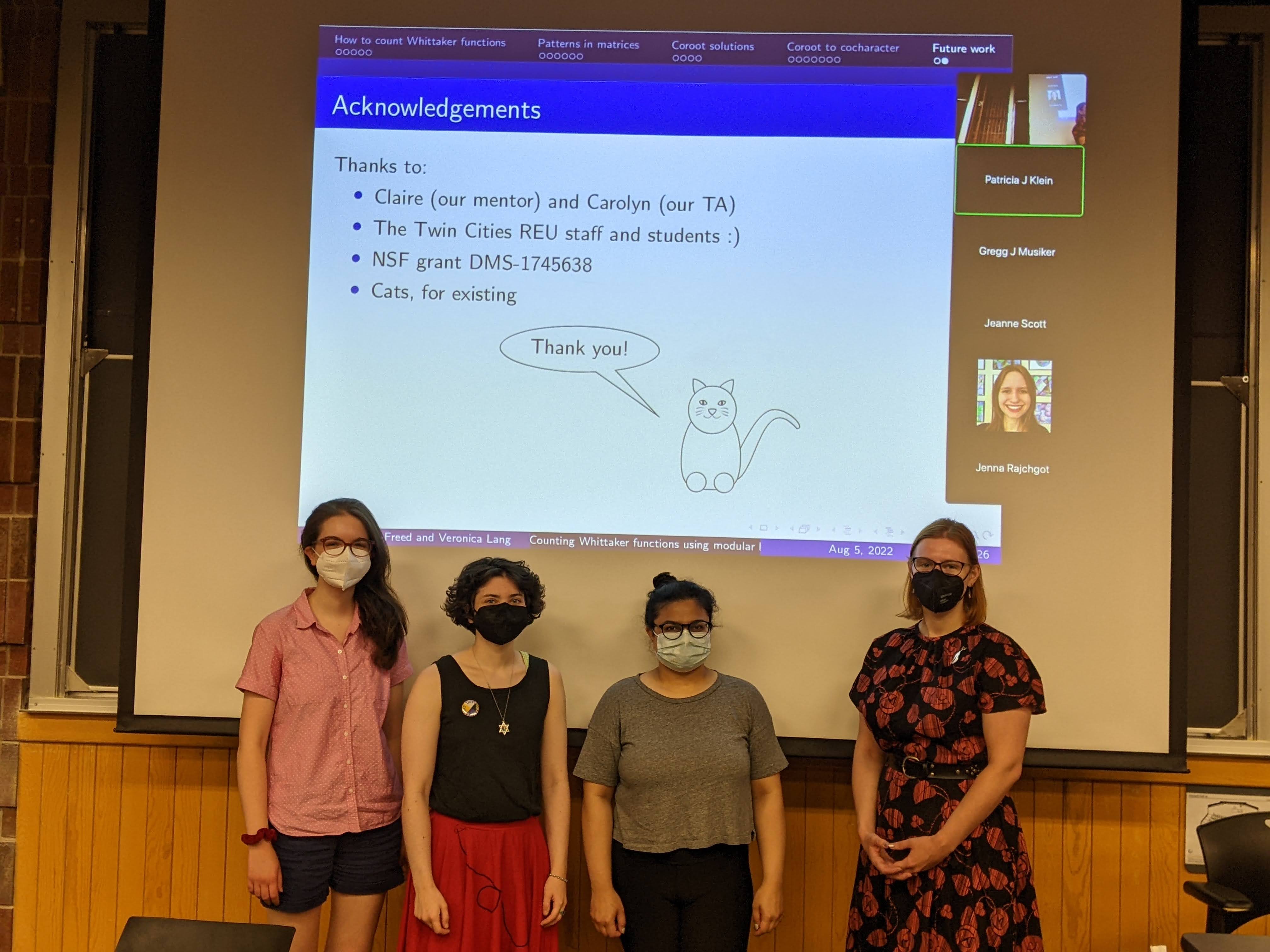
Here is their
group photo,
final presentation,
and report.
Elisabeth Bullock, Noah Caplinger, Ariana Chin, Nyah Davis and Gahl Shemy
studied stable symmetric Grothendieck polynomials and dual weak symmetric Grothendieck polynomials, from the viewpoint of solvable lattice models in statistical mechanics. In particular, they proved a conjectural 5-vertex lattice model for the latter family of polynomials. They also related this model to Pylyavskyy and Yang's puzzle formula for the Littlewood-Richardson rule, which expands two such polynomials back into the same basis.
Here is their
group photo,
group photo at MathProm,
final presentation, and
report.
Frank Lu, Kevin Ren, Dawei Shen and Siki Wang examined relations between Temperley-Lieb immanants, the new notion of %-immanants, and total positivity.
They provided a converse to a theorem of Chepuri and Sherman-Bennett, and connected the question of total positivity for %-immanants to permutation pattern-avoidance.
Here is their
group photo,
final presentation, and
report.
Elisabeth Bullock, Aidan Kelley, Kevin Ren, Gahl Shemy, Dawei Shen, Brian Sun, Amy Tao and Joy Zhang
investigated two questions involving matroids. They first proved shellability for the augmented Bergman complex of a matroid, an object defined recently in work of Braden, Huh, Matherne, Proudfoot and Wang.
Secondly they examined
the weak Lefschetz property for quotients of Stanley-Reisner rings of simplicial convex polytopes, asking
when this property is determined by data which is matroidal in a certain precise sense.
Here is their
group photo,
final presentation, the report (a) on Augmented Bergman complexes with its ensuing arXiv preprint, article in Elec. J. Combin.,
and the report (b) on the weak Lefschetz property.
Polymath Jr. 2021 (online)
Brubaker also mentored again in the 2nd installment of the
Polymath Jr. REU.
TA: Andy Hardt.
Polymath Jr. 2020 (online)
Brubaker and Reiner were also among the mentors for the first-ever pandemic-inspired
Polymath Jr. REU.
TAs: Galen Dorpalen-Barry, Claire Frechette, Elizabeth Kelley, Eric Stucky
Michael Curran, Calvin Yost-Wolff, Sylvester Zhang and Valerie Zhang studied the LLT polynomials defined by Lascoux, Leclerc and Thibon as generating functions for ribbon tableaux. They generalized the interpretation of Schur functions as partition functions for a certain 5-vertex lattice model to a "ribbon lattice model" for the LLT polynomials. They conjecture that these lattice models are exactly solvable/integrable, that is, they satisfy a Yang-Baxter equation, and prove this in the case of 1-,2-, and 3-ribbons. Here is their report and ensuing arXiv preprint.
Quang Dao, Nathan Kenshur, Feiyang Lin, Christina Meng, Zack Stier, and Calvin Yost-Wolff studied the (ordinary) representation theory of central extensions of the untwisted finite groups of Lie type. For al such groups, the universal central extensions, or Schur multipliers, were computed by Steinberg, and only 11 of them are nontrivial. After observing that a parabolic induction strategy for constructing all irreducibles of these universal central extensions is not going to work, the students embark on a Gelfand-Graev strategy, looking for "model" representations. In the process, they come up with several results and conjectures that narrow the search, and if true, would lead to Gelfand-Graev models. Here is their report
Quang Dao, Christina Meng, Julian Wellman, Zixuan Xu, Calvin Yost-Wolff and Teresa Yu introduced a new family of convex polytopes, motivated by a polytopality question arising in work of Lam and Pylyavskyy on certain (linear) Laurent Phenomenon Algebras. These new polytopes extend the well-studied nestohedra, which include permutohedra, associahedra, and graph associahedra. The new polytopes also generalize from undirected graphs to arbitrary building sets the graph cubeahedra introduced by Devadoss, Heath and Vipismakul. After answering Lam and Pylyavskyy's question affirmatively, they study the face numbers for these new polytopes, including interpreting their h-vectors in general, and proving Gal's Conjecture on the nonnegativity of their γ-vectors whenever the polytopes are flag. Here is their report, their arXiv preprint, and their poster at the 2020 JMM.
Quang Dao, Julian Wellman, Calvin Yost-Wolff, and Sylvester Zhang worked on several recent conjectures of Sam Hopkins regarding the a x b rectangle poset and the trapezoidal poset which is its doppelganger, in the sense of Hamaker, Patrias, Pechenik and Williams. This previous work showed that the two posets have the same order polynomial counting their multichains of a given size, but Hopkins conjectured further that they have the same orbit structure for the action of rowmotion on their multichains. He also conjectured a certain homomesy for a statistic on order ideals in the trapezoid poset, which is known for the rectangle posets. Special cases of these conjectures are proven, and some new conjectures are stated that would help to prove more of the conjectures. Here is their report, their arXiv preprint, their paper in Electronic Journal of Combinatorics, and poster at the 2020 JMM. .
C.J. Dowd and Sean McNally examined the following question: given a finite set of points in general position inside a smooth Fano toric variety X, does their vanishing ideal within the Cox ring have a virtual resolution of length dim(X), in the sense of Berkesch-Erman-Smith? A virtual resolution is a complex which is exact and resolves the ideal only up to saturation by the irrelevant ideal. They provide evidence that the answer is affirmative by proving it for several three-folds, and at least one four-fold. Here is their report.
C.J. Dowd, Valerie Zhang and Sylvester Zhang investigated the relationship between arborescences of a graph and arborescences of a covering graph. Galashin and Pylyavskyy's work on R-systems showed that, given a strongly connected directed graph covering another digraph topologically, the ratio of the two edge-weighted sums over all arborescences directed toward a root vertex was independent of the choice of roots. The REU group gives an explicit formula for this ratio for any graph and covering graph in terms of the determinant of the voltage Laplacian introduced by Chaiken. They conjecture that this ratio will always have positive integer coefficients, which they prove in the 2-fold cover case using vector fields. Here is their report, arXiv preprint, and article in Algebraic Combinatorics.
Nathan Kenshur, Feiyang Lin, Sean McNally, Zixuan Xu and Teresa Yu looked at Stanley-Reisner ideals as defining varieties inside of products of projective spaces. They tried to understand when they are virtually Cohen-Macaulay, that is, when do they have a virtual resolution whose length is given by the codimension of the variety they cut out. In addition to coming up with some necessary conditions, they proved that it is sufficient for the associated simplicial complex to be balanced, meaning that every one of its maximal simplices has exactly one vertex from each projective space in the product. Here is their arXiv preprint, to appear in J. Algebra, and their poster at the 2020 JMM
Zack Stier, Julian Wellman and Zixuan Xu followed up on REU 2017 work of Rao and Suk, who had defined a notion of dihedral sieving phenomenon. This is an interesting enumerative property that arises for certain finite sets carrying the action of a dihedral group of order 2m with m odd. One of their main examples involved triangulations and (q,t)-Catalan number of Garsia and Haiman. This REU group generalized this example in at least two directions, one being the Fuss-Catalan generalization that considers quadrangulations, pentangulations, etc. The other direction involved maximal clusters in the cluster complexes of finite type introduced by Fomin and Zelevinsky, and the Cambrian fans of Reading. They also grapple with the question of what dihedral sieving should mean for actions of dihedral groups of order 2m with m even, and come up with some possible answers. Here is their report, their poster from the 2020 JMM, and their arXiv preprint, to appear in Enumerative Combinatorics and Applications.
Yulia Alexandr, Brian Burks, and Patty Commins extended some of Curtis, Ingerman and Morrow's theory of circular planar resistor networks in a disk to the punctured disk case, where one boundary vertex is allowed in the interior of the disk. They prove several results about medial graphs, z-sequenes and local moves that give electrical equivalences in this situation. They also give a sufficient condition for the network to have the conductances recoverable from the response matrix. Here is their report, and the resulting arXiv preprint.
Yulia Alexandr, Patty Commins, Allie Embry, Sylvia Frank, Yutong Li, and Alex Vetter looked for Gelfand-Tsetlin patterns and ice models corresponding to branching rules of various classical groups. In types A and C, such objects are known. In type B (that is, for SO(2n+1, C)), there are various tableau models, due to Sundaram, to Koike-Terada, and to Proctor, but no description of Gelfand-Tsetlin-type patterns or ice models. In particular, for Sundaram's tableau model, they provide the appropriate GT-patterns, strict GT-patterns, Tokuyama-style deformation of the Weyl character, and ice model with Boltzmann weights. Here is their report, and the resulting arXiv preprint.
Johnny Gao, Yutong Li and Amal Mattoo studied homological invariants of a finite set of points in P1 x P1. They give examples where the size of a minimal free resolution for the vanishing ideal of the points depends in a subtle way on the coordinates of the points. They then examine virtual resolutions in the sense of Berkesch, Erman and Smith, which are complexes that resolve the vanishing ideal only up to saturation by the irrelevant ideal. In particular, they give various sufficient conditions and necessary conditions for the points to form a virtual complete intersection, meaning that the ideal has a virtual resolution that takes the form of a Koszul complex. Here is their report, and the resulting arXiv preprint.
Johnny Gao, Jared Marx-Kuo and Vaughan McDonald examined sandpile groups for Cayley graphs of (Z/2Z)r, including the graph of the n-dimensional cube. In all cases, one already knows the p-primary component of these sandpile groups for odd primes p, but the 2-primary component remains difficult to describe. They use ring theory and linear algebra to give a sharp upper bound for the largest power m occurring in its Z/2mZ summands, along with determining the number of even invariant factors in "generic" cases. They also give a surprisingly precise description in the hypercube case for the invariant factors with largest few powers of 2. Here is their report, their resulting arXiv preprint, and their poster that got an MAA Outstanding Poster Award at the 2019 JMM.
Johnny Gao and Vaughan McDonald studied the f-vector and cd-index of a weight polytope (or Wythoff polytope), which is the convex hull of the orbit of point in space under the action of a finite reflection group. They show that a formula of Renner for the f-vector in the Weyl group case is also valid for arbitrary reflection groups, via results of Maxwell. They then use this to continue work begun by Golubitsky, giving generating functions for the f-vectors in all of the cases where the weight polytope is simple. They then use Maxwell's results to study the cd-index in non-simple cases, including giving a generating function that lets one compute the cd-indices of all hypersimplices. Here is their report, and slides from their talk at JMM 2019.
Meghal Gupta derived a formula for the F-polynomial of a cluster variable of a quiver in terms of its C-matrix entries. She then applies it in two ways, first to give simple formulas for the F-polynomials for specific classes of quivers. Secondly she uses it to study a kind of convergence of the F-polynomials to stable limits, after making a monomial change-of-basis based on the C-matrices, that had been conjectured by physicists Eager and Franco. She proves this convergence in a fairly general setting, along with exact formulas for these stable limits in some specific cases. Here is her report, and the resulting arXiv preprint.
Jared Marx-Kuo, Vaughan McDonald, John O'Brien, and Alex Vetter examined the representation theory of symplectic rook monoids and their Hecke algebras. After proving a general version of the Borel-Matsumoto Theorem for algebraic monoids, they focus on the symplectic rook monoid, determining a character table for it, modeled on the analogous table given by Solomon for the usual rook monoid. Their results also extend to the Hecke algebras for the rook and symplectic rook monoids. Here is their report. along with two resulting arXiv preprints, one on Borel-Matsumoto, one on character tables.
Piriyakorn Piriyatamwong and Caledonia Wilson looked at F-polynomials for cluster variables in type D cluster algebras, and gave a new combinatorial interpretation for them using mixed single-double dimers. Here is their report.
Anna Brosowsky, Neeraja Kulkarni, Alex Mason, Joe Suk and Ewin Tang examined the semigroup of all n-by-n real matrices which are k-nonnegative in the sense that all their minors of size k or less are nonnegative. They give a generating set for these k-nonnegative matrices, as well as relations for certain special cases, i.e. the k = n-1 and k=n-2 unitriangular cases. In the above two cases, they partition the k-nonnegative matrices into "Bruhat-like" cells, which are homeomorphic to open balls, and study the closure of these cells. In addition, they have a set of k-positivity tests, which imply that the sets of k-positive matrices are in bijection with 1-positive matrices for all k. These tests give rise to cluster algebras which live in the total positivity cluster algebra. Here is their report, a resulting arXiv preprint and another arXiv preprint, a poster and another poster, along with a talk from the 2018 JMM in San Diego.
Marisa Gaetz, Will Hardt, Shruthi Sridhar, and Anh Tran examined the question of when the skew Schur functions for two connected ribbon skew shapes have the same support in their Schur function expansion. Work of McNamara showed that such support-equality requires the list of row sizes for the two shapes to be permutations of the same partition. This group studied which partitions have support-equality among all of their permutations. They show a simple sufficient condition for this to occur (all triples of parts in the partition satisfy the strict triangle inequality). They also prove a necessary condition, which they conjecture to be necessary and sufficient in general, and prove this holds for ribbons with at most 4 rows. Here is their report, and the resulting arXiv preprint, and their poster from the 2018 JMM in San Diego.
The same group of Marisa Gaetz, Will Hardt, Shruthi Sridhar, and Anh Tran explored how the avoidance of a pattern within a random permutation correlates with the avoidance of another pattern. It turns out that a result of Marcus and Tardos shows they are almost always positively correlated. However things become interesting when one looks at how the same events correlate among only the permutations that avoid some fixed third pattern. Here is their report.
Thomas Hameister generalized Chapuy and Stump's exponential generating function that counts reflection factorizations of any length for a Coxeter element in a well-generated complex reflection group. The generalization keeps track of how many reflections lie in the various hyperplane orbits, and still factorizes beautifully into a product. It also uncovers a new fact about such groups which one might paraphrase as saying that each hyperplane orbit "knows" the Coxeter number h, proven case-by-case (and later derived in a case-free fashion by J. Michel). Here is his report, and the resulting arXiv preprint.
Thomas Hameister, Connor Simpson and Sujit Rao examined the Hilbert series of Chow rings for matroids, which were introduced by Feichtner and Yuzvinsky in 2003, and used by Adiprasito, Huh, and Katz in their recent proof of the Mason and Rota-Heron-Welsh conjectures. Among other things, they give explicit combinatorial descriptions of the Hilbert series for uniform matroids and their q-analogues coming from finite vector spaces, relating them to work q-Eulerian polynomials studied by Shareshian and Wachs, and q-secant numbers of Foata and Han. Here is their report,, and the resulting arXiv preprint.
Alex Mason and Shruthi Sridhar answered a question by Jim Propp, about whether the codewords of certain cyclic codes exhibit a cyclic sieving phenomenon. Specifically, Propp had asked about whether the generating function X(t) that counts codewords according to either of two natural statistics (major index, inversion number) had the property that the number of codewords fixed under a power cd of the cyclic rotation on positions is given by evaluating X(t) at t a primitive d-th root-of-unity. This turns out to be true for well-known reasons for a few trivial codes (repetition, parity check). However, when using the major index statistic, it also works for nontrivial reasons that involve linear feedback shift registers for the dual Hamming codes over finite fields Fq with certain predictable values of q, including q=2,3. Similarly when using the inversion statistic, it again works for the dual Hamming codes at q=2. Here is their report.
Sujit Rao and Joe Suk extended cyclic sieving phenomena to actions of other finite groups, besides cyclic groups and their products. They came up with a notion of a sieving phenomenon for a finite group along with a choice of generators for its representation ring, which seems particularly well-behaved for dihedral groups of order 2n with n odd. They exhibit several examples of such a dihedral sieving phenomenon involving the Fibonomials of Amdeberhan, Chen, Moll and Sagan. Here is their report, and the resulting arXiv preprint.
Ewin Tang explored instances of "The Rule of Three", as discussed by Kirillov and by Blasiak and Fomin. This is a situation where one has a family of elements in a ring containing noncommutative variables, and all members of the family commute precisely when the those members that involve one, two or three variables commute. An example are elementary symmetric functions in noncommuting variables. Tang considered Schur Q-functions and loop symmetric functions, finding a conjectural Rule of Three for the former, and negative results for the latter. Here is his report.
Ethan Alwaise, Shuli Chen, Yoa Clifton, Rohil Prasad, Madeline Shinners, and Albert Zheng examined the question of when two skew (stable) Grothendieck polynomials Gλ/μ are equal, and when two skew dual (stable) Grothendieck polynomials gλ/μ are equal. Among ribbon skew shapes, they proved that their two dual stable Grothendiecks coincide if and only if the shapes are 180-degree rotations of each other; they conjecture the same holds for the ribbon stable Grothendiecks. They also proved some necessary conditions for equality of arbitrary skew dual stable Grothendiecks, and gave many conjectures. Here is their report and their arXiv preprint, which appeared in Involve 11 (2018), 143--167.
Ben Anzis and Rohil Prasad re-examined the thorny problem of computing the exact structure of the critical/sandpile group of the n-dimensional cube graph, and some related Cayley graphs. This critical group is a finite abelian group, whose p-primary structure is completely known for all odd primes p since work of H. Bai, but its 2-primary structure remains very mysterious. Among Anzis and Prasad's results, they bound the largest power of 2 in its order by 2n+log2(n), they pursue a Groebner basis approach to the number of occurrences of Z/2Z in the 2-primary structure, and they analyze the p-primary parts for odd primes p in the higher-dimensional critical groups of n-cubes. Here is their report.
Ben Anzis, Shuli Chen, Yibo Gao, Jesse Kim, and Zhaoqi Li examined
a probabilistic question on symmetric functions: if one assigns to each of the elementary
symmetric functions e1, e2, ... values chosen independently and
uniformly at random from the finite field Fq, what is the probability
that the Schur function sλ vanishes?
They showed that the probability is
-- always at least 1/q,
-- always asymptotically 1/q when q is large, and
-- equals exactly 1/q if and only if λ is either a hook, rectangle, or staircase partition.
Additionally, they exhibit some λ for which the probability is (q2+q-1)/q3,
and others for which it is not a rational function in q,
although they conjecture that it always takes the form f(q)/qk for some quasi-polynomial f(q).
Lastly, they examine the distribution of values of Jacobi-Trudi determinants, and also the
question of when the vanishing of sλ, sμ are independent.
Here is their report
and their arXiv preprint,
which appeared in Annals of Combinatorics 22 (2018), 447--489.
Alexander Clifton and Peter Dillery studied two lattices associated to a plane tree T that were recently introduced by Garver and McConville: the (congruence-uniform) lattice Bic(T) of biclosed sets, and the lattice of noncrossing tree partitions NCP(T), generalizing the usual weak Bruhat order on permutations and the usual lattice of noncrossing set partitions respectively. Clifton and Dillery showed that NCP(T) is graded and rank-symmetric, and constructed a CU-labeling (in the sense of Reading) for Bic(T). Here is their report, and their arXiv preprint, to appear in Algebra Universalis.
Yibo Gao, Ben Krakoff and Lisa Yang studied the facial structure of the Gelfand-Tsetlin polytope GT(λ) associated to an integer partition λ. They computed both the exact diameter, and the exact automorphism group, as a function of λ. They also discuss some particular special cases. Here is their report, and their arXiv preprint, which appeared in Disc. and Comput. Geom. 62 (2019), 209--238, and got an MAA Outstanding Poster award at the 2017 JMM.
Yibo Gao, Zhaoqi Li, Thuy-Dong Vuong and Lisa Yang produced explicit formulas for cluster variables when one performs certain mutation sequences (the toric ones) on the del Pezzo - 2 quivers that appear in physics and brane tiling. The formulas are combinatorially interpreted as the sums over perfect matchings of subsets of the brane tiling. Here is their report and their arXiv preprint, which appear in Elec. J. Combinatorics 26, Issue 2 (2019), and got an MAA Outstanding Poster award at the 2017 JMM.
Grace Zhang studied a transformation of Fomin and Zelevinsky's F-polynomials for cluster variables in quivers, suggested by Eager and Franco to stabilize in a certain way for the dP1 (del Pezzo-1) quiver, and conjectured to always stabilize. Zhang showed that such stabilization occurs for the Kronecker and Conifold quivers, and combinatorially interprets the stable coefficients in those cases. Here is her report, and her arXiv preprint.
Colin Aitken worked on hyperdeterminants of higher tensors over a field F, which generalize determinants of 2-tensors or matrices, and were studied by Cayley, Gelfand-Kapranov-Zelevinsky, and others. Aitken studied the set of nondegenerate 3-tensors in F2 ⊗ Fk ⊗Fk+1, that is, those having nonvanishing hyperdeterminant. Letting GLk denote the invertible k x k matrices over F, he showed that the set of such nondegenerate 3-tensors carries a transitive action of GL_k x GLk+1 acting in the second and third tensor positions, with the kernel of the action isomorphic to Fx. Thus it is a homogeneous space (GL_k x GLk+1)/Fx, which identifies its topology when F is a topological field, and shows that it has cardinality qk^2 (q-1)2k [k]!q [k+1]!q when F is a finite field having q elements. This last fact generalizes an unpublished result of Musiker and Yu. Here is his report.
Louis Gaudet, Pro Jiradilok, Ben Houston-Edwards and James Stevens worked on the Mirror Symmetry Conjecture of Lam and Pylyavskyy. This conjecture deals with a notion of (weighted oriented) networks on surfaces, where one can has four natural classes of measurements that one can associate to homology classes of paths, cycles and flows in the network, the highway (resp. underway) measurements of types I and II. The conjecture asserts that the algebras generated by all four classes of measurements are the same-- in a very special case it is the assertion that the elementary symmetric functions and the complete homogeneous symmetric functions both generate the same ring, namely all symmetric functions. The students were able to show that the conjecture holds for a large class of networks on a torus, called (n,m,k)-torus networks. Additionally, they show that the general conjecture would follow from a simpler-sounding conjecture regarding complementation of flows. Here is their report.
Pro Jiradilok extended into corank 3 the classification of zonotopes and orientations (or chambers in hyperplane arrangements, or topes in realized oriented matroids), whose monotone paths are all coherent. This had been achieved in coranks 0,1,2 by the PhD thesis of Rob Edman. The corank 3 classification is completed under a certain genericity assumption. Here is his report.
Pro Jiradilok and James Stevens described an infinite family of non-Pluecker cluster variables inside the double Bruhat cell cluster algebra defined by Berenstein, Fomin, and Zelevinsky. These cluster variables occur in a family of subalgebras they call Double Rim Hook (DRH) cluster algebras, and all the cluster variables are determinants of matrices of special form. Here is their report.
Adam Keilthy, Lillian Webster, Yinuo Zhang and Shuqi Zhou studied the K-theoretic and shifted analogue of jeu-de-taquin. They showed that Buch and Samuel's weak K-Knuth-equivalence is compatible with the shifted Hecke insertion of Patrias and Pylyavskyy. This allowed them to define a K-theoretic analogue of Jing and Li's shifted Poirier-Reutenauer Hopf algebra, and to derive a new symmetric function that corresponds to K-theory of the orthogonal Grassmannian OG(n,2n+1), as well as prove a Littlewood-Richardson rule for these symmetric functions. Here is their report and their arXiv preprint, which appeared in J. Combin. Theory Ser. A 151 (2017), 207-240.
The same team of Adam Keilthy, Lillian Webster, Yinuo Zhang and Shuqi Zhou investigated the involution word analogue of Knutson and Miller's subword complexes for factorizations in Coxeter groups. In the involution word setting, they showed that these simplicial complexes again are shellable balls and spheres. For certain particular cases in symmetric groups, they showed that the subword complex is polar dual to an associahedron. Here is their report.
Christian Gaetz, Michelle Mastrianni, Hailee Peck, Colleen Robichaux, David Schwein, and Ka Yu Tam (mentored by Rebecca Patrias) examined the K-theoretic analogue of RSK insertion and the K-Knuth equivalence, focussing on unique rectification targets: the increasing tableaux whose row words have no other tableaux row words within their K-Knuth equivalence class. They give several new examples of such tableaux, along with an algorithm to determine if two words are K-Knuth equivalent. Their poster on this topic won an Outstanding Presentation Award in the MAA Undergraduate Poster Session at the 2015 Joint Mathematics Meetings. Here is their arXiv preprint, which appeared in Elec. J. Combin. 23 (2016).
Christian Gaetz, Kyle Meyer, Ka Yu Tam, Max Wimberley, Zijian Yao and Heyi Zhu examined Dennis White's conjecture (from arXiv:0903.2831) on what he calls the (n,k)-Schur cone: the positive cone within the symmetric functions of degree n spanned by all products of Schur functions indexed by partitions with at most k parts. White showed for k=2 that the extreme rays of the cone can only come from products which are nested in a certain sense, and conjectured that these nested products actually are all extreme, proving this extremeness for a subclass of them. The students provide a simplified proof for this subclass, and proofs for some other subclasses, lending further support to the conjecture. They also collect some further data on the extreme rays of the (n,k) Schur functions for higher values of k. Here is their report and their arXiv preprint.
Jacob Haley, David Hemminger, Aaron Landesman, and Hailee Peck generalized a 2013 result of Barot and Marsh, who had shown that mutating an orientation of the Dynkin diagram of a finite Weyl group W allows one to correspondingly "mutate" the usual Coxeter presentation for W into a new and different presentation. Their generalization shows how to "mutate" the usual presentation of the (generalized) braid group for W into a new and different presentation. They also conjecture an analogous lifting to braid groups of a result of Felikson and Tumarkin for affine Weyl groups W. Here is their report and their arXiv preprint, which appeared in Algebras and Representation Theory 20 (2017), 629--653
David Hemminger, Aaron Landesman, and Zijian Yao defined a new construction on a graded poset P called its edge poset E(P). They conjectured, and proved in many interesting cases, that if one starts with a a Boolean algebra Bn of rank n and forms the quotient by any subgroup G of the symmetric group, the quotient poset Bn/G which is well-known to be Peck, will have has its edge poset E(Bn/G) also Peck. This was motivated by a special case of a recent unimodality result of Pak and Panova, where Bn/G is the poset of Ferrers diagrams inside a rectangle. Here is their report, and their arXiv preprint, which appeared in Order 34 (2017), 441--463
Aaron Landesman proved a combinatorial conjecture by Stasinski and Voll that arose in their work on zeta functions for classical groups. The result asserts that a signed generating function sum for a certain length-like statistic over descent classes in the hyperoctahedral group has a simple q-multinomial-like product formula. Here is his arXiv preprint, which appeared in Australasian J. Combin. 71 (2018), 196--240.
Kyle Meyer showed that the number of ways of tiling a planar figure using only horizontal 1-by-l and vertical m-by-1 polyominoes is #P-complete if max(l,m) is at least 3 (and min(l,m) is at least 2). This lies in between two known results: a result of Beauquier, Nivat, Remila and Robson showing that deciding the existence of such a tiling is NP-complete, and work of Kasteleyn showing that counting tilings by 1-by-2 and 2-by-1 dominos is the same as counting perfect matchings and can be done in polynomial time. Here is his report .
Mariya Sardali, Max Wimberley and Heyi Zhu studied quivers with vertices labeled 1,2,..,n which are periodic with period 2, in the sense that performing quiver mutation at vertex 1 and then at vertex 2 is isomorphic to the original quiver after relabeling (1,2,...,n) as (n-1,n,...,1,2,...,n-2). Among other things, they classifed all such period 2 quivers with 6 nodes, and found some infinite families of period 2 quivers of larger sizes. Here is their report .
Zijian Yao proved a conjecture of Max Glick regarding Schwartz's pentagram map on polygons. Schwartz had shown that when one performs n-1 iterates of the pentagram map, starting from an axis-aligned 2n-sided polygon, all of the vertices collapse to a single point; Glick had conjectured that this point is the barycenter of the original polygon. Yao proved this, along with variations for analogues of the pentagram, both in higher dimensions and in lower dimensions. Here is his report, and his arXiv preprint.
Josh Alman, Cesar Cuenca and Jiaoyang Huang studied recurrences that exhibit Laurent phenomenon. Some of the most famous among these are the Somos and the Gale-Robinson recurrences. Their approach is based on finding period 1 seeds of Laurent phenomenon algebras of Lam-Pylyavskyy. The main results include a complete classification in rank three, finding many new interesting families of examples, and generalizing a result of Fordy and Marsh to binomial seeds that do not fit into the setting of cluster algebras. Here is their report, and the arXiv preprint.
Josh Alman, Carl Lian and Brandon Tran proved a host of new results on circular planar electrical networks, following de Verdiere-Gitler-Vertigan and Curtis-Ingerman-Morrow. They construct a poset of electrical networks with n boundary vertices, and prove that it is graded by number of edges of critical representatives. They conjecture that the poset is Eulerian and prove an initial result in this direction. Also, adapting methods of Callan and Stein-Everett, they answer a variety of enumerative questions; notably, they give the number of elements of the poset (i.e., the number of equivalence classes of underlying graphs of electrical networks, or equivalently the number of cells in the space of response matrices). Alman, Lian and Tran also study positivity phenomena of the response matrices arising from circular planar electrical networks, extending work of Kenyon-Wilson and Postnikov. In doing so, they introduce electrical positroids, and discuss a naturally arising example of a Laurent phenomenon algebra, as studied by Lam-Pylyavskyy. Here is their report, and two resulting arXiv preprints, Part I being more on the electrical posets, and Part II more on the positivity phenomena. These two preprints were later combined in a single paper, that appeared in J. Combin. Theory Ser. A. (2015).
Cesar Cuenca studied the cluster algebras associated to double wiring diagrams that were introduced by Fomin and Zelevinsky, aiming toward the conjecture that any of their cluster variables is Schur positive when it is evaluated on a generalized Jacobi-Trudi matrix. Already an interesting special case of this conjecture is that of cluster variables which are one mutation step away from a double wiring diagram, and he proves it in the case where that one step is a mutation at a chamber of degree at most 6, using theory of Temperley-Lieb immanants. Here is his report.
Jiaoyang Huang, Andrew Senger, Peter Wear, and Tianqi Wu examined partition identities that appeared in a recent paper of Buryak and Feigin. Using algebraic geometry, the latter authors had shown the following two statistics on the set of partitions of n are equidistributed: the number of cells of the Ferrers diagram whose hook difference (the difference of its leg and arm lengths) is one, versus the largest part of the partition that appears at least twice. Haung, Senger, Wear and Wu prove this combinatorially in some special cases. They propose refinements of the Buryak and Feigin result and prove them in some cases combinatorially. In addition, they obtain a new formula for the q-Catalan numbers which naturally leads them to define a new q,t-Catalan number with a simple combinatorial interpretation. Here is their report and their arXiv preprint.
Megan Leoni, Seth Neel and Paxton Turner studied combinatorial aspects of cluster algebras motivated from the physics literature, building off of previous work from 2012 REU student Sicong Zhang. In particular, they explored new algebraic properties of the well-studied del Pezzo 3 (dP3) quiver and geometric properties of its corresponding brane tiling. This includes a factorization formula for the cluster variables arising from a large class of mutation sequences (called τ-mutation sequences) and construction of a new family of subgraphs of the dP3 brane tiling which they call Aztec Castles. Leoni, Neel, and Turner proved that for each τ-mutation sequence (which also corresponds to a path in the Affine A2 Coxeter Lattice), there is an Aztec Castle whose weighted number of perfect matchings agrees with the Laurent expansion for the associated cluster variable. Here is their report, and the arXiv preprint, which will appear in J. Physics A.
Abby Stevens and Shannon Gallagher studied a family of Laurent phenomenon algebras that are close to Ptolemy cluster algebras. It turns out that if if you "break" an arrow in a type A mutation class quiver, the resulting LP algebra is of finite type, and in some sense is still controlled by triangulations of a polygon. They prove the structural properties for a specific family of such algebras. Here is their report
Rediet Abebe and Joshua Pfeffer studied simplicial complex generalizations of two conjectures on the graph Laplacian eigenvalues. The first generalizes the Grone-Merris conjecture, which is known for graphs by work of H. Bai, but wide open in all higher-dimensions. Abebe and Pfeffer make progress toward the second inequality in this conjecture for 2-dimensional complexes. The second generalization is of a conjecture of A. Brouwer for graphs that is still open. They give several potential generalizations, including one which they verify both for shifted complexes and for simplicial trees in the sense of S. Faridi. Here is their report.
Eric Chen and Dennis Tseng proved the recent "Splitting subspace" conjecture of S. Ghorpade and S. Ram, answering a 15-year-old question of Niederreiter: in a degree mn extension of the finite field Fq when one chooses a primitive element σ, how many m-dimensional Fq-subspaces W have the property that the n different translates W,σW,σ2W,...,σn-1W "split" the extension as a direct sum? Chen and Tseng prove Ghorpade and Ram's conjecture that this number is [n]q^m qm(m-1)(n-1), independent of σ. Their method lets them compute a product formula for a far-reaching generalization of this enumeration problem. Here is their report, and their arXiv preprint, which will appear in the journal Finite fields and their applications.
Xin Chen and Jane Wang studied the so-called "super Catalan numbers" S(m,n) = (2m)!(2n)!⁄m!n!(m + n)! of I. Gessel. S(m,n) is known to be an integer, and has a combinatorial interpretation due to Gessel and Xin for m=2,3. Chen and Wang give simple lattice path interpretations for S(n,m) when n-m is at most 3, and a not-so-simple such interpretation for n-m=4. In addition, their methods give them expressions for the q-analogues of S(m,n) as polynomials in q with nonnegative coefficients for n-m at most 3. They also give some connections of S(m,n) with annular noncrossing partitions, and examine some other ratios of factorials that turn out to be integers, including conjectures about q-analogues having nonnegative coefficients as polynomials in q. Here is their report, and their arXiv preprint.
Horia Mania worked on Wilmes' Conjecture on the Betti numbers in the minimal free resolution of certain ideals related to abelian sandpiles. He used Hochster's formula to prove the conjecture for the first Betti number, and introduced ideas, such as boundary divisors, that may be helpful for a combinatorial proof for the higher Betti numbers.
Here is his report,
and his arXiv preprint.
In independent work appearing Fall 2012, two groups, Mohammadi and Shokrieh
(their arXiv preprint)
and Manjunath, Schreyer, Wilmes
(their arXiv preprint)
used alternative algebraic methods to prove the conjecture for all Betti numbers.
Dennis Tseng considered maps induced on critical groups by graph coverings. For n-sheeted coverings, the map on critical groups surjects, and splits at primes p not dividing n. For regular coverings one can identify its kernel as a naturally defined "critical group" of the voltage graph describing the covering. For double covers, the voltage graph is a signed graph with critical group defined in terms a Laplacian matrix that appears in work of Zaslavsky. One can generalize this to a notion of "double coverings" of signed graphs, and use this to reinterpret a result of H. Bai on the p-primary structure of the critical groups of n-cubes for odd primes p. Here is his report, and the ensuing arXiv preprint with Reiner, which appeared in Discrete Mathematics (2014).
Sicong Zhang studied combinatorial aspects of cluster algebras motivated from the physics literature. In particular, string theorists such as A. Hanany and R.-K. Seong study certain families of quivers and construct duals for them given as tilings of a torus, known as a brane tiling. Zhang investigated several such examples, including a six-vertex quiver associated to the dP_3 lattice. Certain subgraphs of this tiling were previously studied by C. Cottrell-B.Young and M. Ciucu after being introduced by J. Propp under the name Aztec Dragons. Zhang proved that a certain infinite sequence of cluster variables associated to this quiver has the property that their Laurent polynomial expansions can be expressed, under a suitable weighting scheme, in terms of perfect matchings of these subgraphs. Here is his report.
Rohit Agrawal and Vladimir Sotirov examined a real cone inside the group algebra of the symmetric group Sn, introduced by Stembridge, dual to the cone of monomial-positive immanants of n-by-n matrices. Stembridge showed that this cone has finitely many extreme rays for n at most 5, and asked if there are finitely many in general. Agrawal and Sotirov present some general relations among the generators of the cone, and use this to exhibit its (finitely-many) extreme rays for n=6. Here is their report.
Rohit Agrawal, Vladimir Sotirov and Fan Wei
made more explicit a bijection of Cools et al.
between rectangular standard Young tableaux
and G-parking functions as representatives for chip-firing
groups on certain graphs G. They then used this to prove
that, under the bijection, the evacuation involution on
tableaux corresponds to vertical reflection of the graph.
Here is their report,
and the
published version
(Elec. J. Combin. 20(3):P33, 2013) written with Gregg Musiker.
(Fan Wei later received the 2012 AWM Alice T. Schafer Prize
in part for this work.)
Francisc Bozgan attempted to prove a conjectural Jacob-Trudi-style determinant formula for the dual stable Grothendieck polynomials of Lam and Pylyavskyy, corresponding to a partition. He has so far has proven it in the case where the partition has at most two columns in its Ferrers diagram, using the notion of elegant fillings. Here is his report.
Jehanne Dousse investigated a question suggested by this recent theorem of John Stembridge, motivated by the digraphs governing Kazhdan-Lusztig cell representations of Coxeter groups: for a fixed integer polynomial p(x), there are only finitely many strongly-connected digraphs whose adjacency matrix A satsifies p(A)=0. For quadratic p(x), Dousse classifies these digraphs completely. For cubic and higher degree p(x), she gives a necessary condition. She also analyzes the solutions of maximal size for some particular families of polynomials, using known results on strongly regular graphs and the directed line graph construction. Here is her report.
Daniel Hess and Benjy Hirsch showed that the simplicial complexes of strongly and weakly separated subsets of {1,2,..,n}, after removing cone points, have the homotopy types of an (n-3)-sphere and a point, respectively. Furthermore, they show that one has equivariant homotopy equivalences with respect to a natural Z/2Z x Z/2Z-action. Here is their report, and their arXiv preprint, which has appeared in Topology and its Applications (160 (2013), pp. 328-336).
In-Jee Jeong proved explicit formulas for certain cluster variables in cluster algebras derived from planar bipartite graphs, when one performs particular sequences of mutations. The formulas turn out to be generating functions for perfect matchings of certain subgraphs of the original graph. Here is his report.
Shiyu Li investigated patterns generated by sequences of quiver mutations using the theory of cluster algebras. Starting with a certain cyclic quiver, she demonstrated relations between the sequences obtained via mutations and the Fibonacci numbers. Here is her report.
David B Rush and Danny Shi showed that for any minuscule poset P, one has a cyclic sieving phenomenon for the triple (X,X(q),C) in which X is the set of order ideals of P or of P x [2] (where [2] is a 2-element chain), X(q) is the q-count for the orders by cardinality, and C is the cycle group generated by the action on order ideals or antichains of P considered by Duchet, Brouwer-Schrijver, Fukuda, Cameron-FonDerFlaass, and Panyushev at various levels of generality. Their proof for P is case-free, and uses the theory of minuscule heaps and fully commutative elements, while the proof for P x [2] uses the classification of minuscule posets. Here is their report, and their arXiv preprint; the paper appeared in J. Algebraic Combinatorics (37 (2013), pp. 545--569), and is also discussed in R.M. Green's book "Combinatorics of minuscule representations" (Section 11.3).
We performed experiments in Maple to guess the structure of the critical group for threshold graphs. A conjecture was formed in the "generic" case, and proven in some very special cases. See the REU report on the Math REU page.
Mulvaney produced software for visualizing algebraic curves in the real affine plane using MATLAB. In particular, one can use it to animate one-parameter families of such curves. See the REU report on the Math REU page.
Some related preprints
Back to
Math Home Page
Back to Math REU Page
Back to Reiner's Home Page
The view and opinions expressed in this page are strictly those of the page author. The contents of this page have not been reviewed or approved by the University of Minnesota.